By: Lauren Root
The Sept. 30 Every Child Matters Walk serves as a reminder that reconciliation requires continued action and education. It also requires solidarity. While the tragedies of Canada’s past cannot be undone, the Bishop’s community and the wider Lennoxville community’s willingness to come together demonstrates the importance of acknowledging these injustices and working towards a future in which every child is valued and protected.
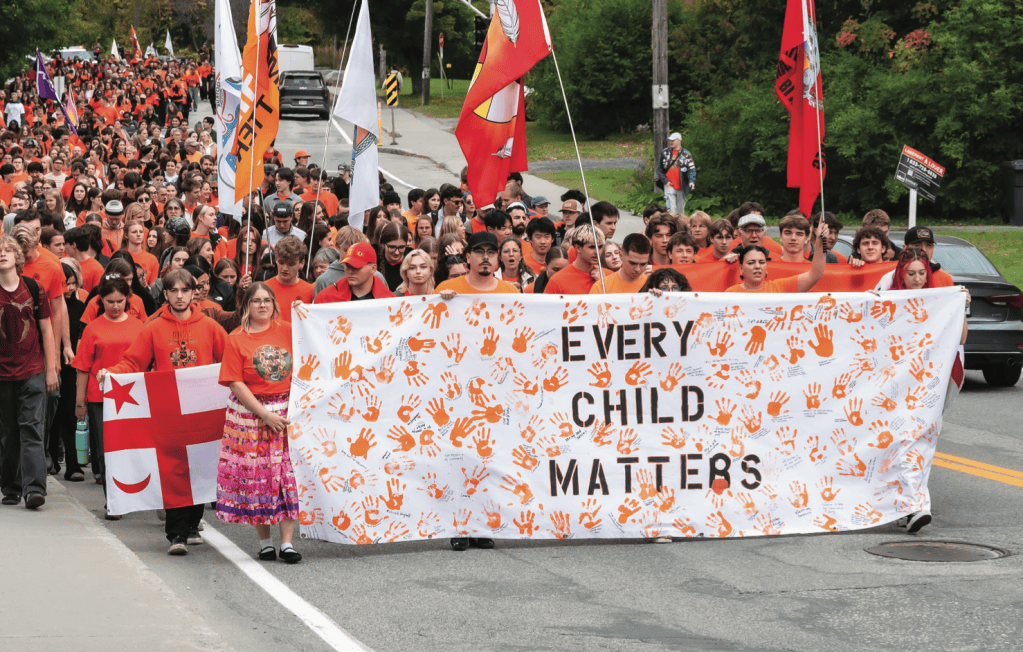
Photo courtesy of Indigenous Student Success Centre
The atmosphere of the day was respectful, reflective, and meaningful. Hun- dreds of people, many of whom were not Indigenous, gathered to show their support for a cause that has long been swept under the rug. The outpouring of support from the community on the National Day for Truth and Reconciliation shows that Indigenous and non-Indigenous peoples can collaborate and come together with the intention of protecting children and continuing to advocate for those who cannot speak for themselves.
Sept. 30 marked the fifth National Day for Truth and Reconciliation in Canada. At Bishop’s University, hundreds gathered on Coulter Field for a gathering of reconciliation, followed by a walk through Lennoxville. The gathering on Coulter Field brought a culmination of a week of activities surrounding truth and reconciliation, with Indigenous learning and appreciation events happening around campus.
Sept. 30 may be the National Day for Truth and Reconciliation, but at Bishop’s, reconciliation efforts happen year-round. This national day of recognition is significant because it highlights the genocide carried out against Indigenous communities in Canada, and shows Canada’s intention, as a country, to reconcile with the horrors of the past and present to move toward a unified future.
The crowd on Coulter came from all different backgrounds and were of all different ages. Students from Bishop’s College School, Alexander Galt High School, Champlain College Lennoxville, University of Sherbrooke, Cégep of Sherbrooke, Cégep of Granby, and Bishop’s University gathered alongside members of Lennoxville and the greater Sherbrooke community.
The day began at 12:30 p.m. with a powerful land acknowledgment by Murray Johnston, a professor from the Liberal Arts department at Champlain College Lennoxville. His land acknowledgment included his family’s history and their deep ties to Indigenous lands and culture, showing how non-Indigenous peoples can stand in solidarity with the Indigenous community, working on settler accountability and responsible allyship.
There were many personal testimonies and cultural teachings shared by Indigenous community members. Maya Cousineau Mollen, an Innu woman from Ekuanitshit, spoke about the harms being done against Indigenous peoples across Canada. Her speech shows that while Canada has begun the process of reconciliation, there is still a long way to go, and Indigenous peoples are still facing harms today.
Julie-Ann Vollant-Whittemore, Innu from Maliotenam, Quebec, and a fourth-year Psychology student, gave a moving testimony of her experiences and some of the systemic difficulties she has faced because of the oppression against Indigenous peoples and residential schools. Julie-Ann’s speech was hopeful too. She has overcome tragedy and difficulty to achieve her goals, to receive a university degree, and spoke about hoping to give back to her community. It was powerful to hear her life story and how she has overcome much adversity to be standing where she is today. Her courage and bravery shone through the words she spoke, surely inspiring young Indigenous children in the crowd.
Notably, the orange shirts sold on campus feature a graphic art design. The Indigenous Student Success Center held a logo contest for the first time in which Indigenous students from Bishop’s and Champlain were encouraged to submit a drawing, and Julie-Ann’s design won. In her testimony, she referenced her art and how it’s a creative outlet for her, allowing her to express her feelings and fears, her emotions and dreams.
The speeches given throughout the ceremony made it clear that every child matters, and every child in history has mattered. The children taken from their homes, many of whom never returned, mattered. The children now, who continue to struggle with systemic issues, such as mental illness and addiction, as a direct result of residential schools, matter.
The Office of Indigenous Initiatives unveiled a map of the W8banakiak, the people whose territory Bishop’s University is located on. Two of these maps were installed in the John H. Price Sports and Recreational Center. This is a significant step in creating visibility on campus and creating more spaces for learning and acknowledgment of the land we gather to learn, work, and play on. The community was fortunate to have someone who works for the ‘Office de la Langue Abenakis’, Lois Dana, a Penobscot member of Indian Island, come explain the map and its many meanings and significance to the W8banaki people.
After the gathering and testimonies, the crowd in attendance walked together through Lennoxville, displaying banners and signs bearing the words ‘Every Child Matters’, and showing their unity with Indigenous peoples. Hundreds of people filled the streets of Lennoxville, wearing orange shirts and using their voices to continue to protect children and raise awareness.