By Tallula Russell
The colour of the day at the Hindu Mission of Canada’s Montreal temple is a bright, almost neon orange. The Murti, icon statues of Hindu deities, are dressed in elaborate orange clothing with gold and green trim. The statues of the five gods are white, evoking marble or porcelain, with silver crowns and colourful leis alongside their regal orange regalia. They sit in a raised section of the main room of the temple, set behind gold bannisters to demarcate their place.
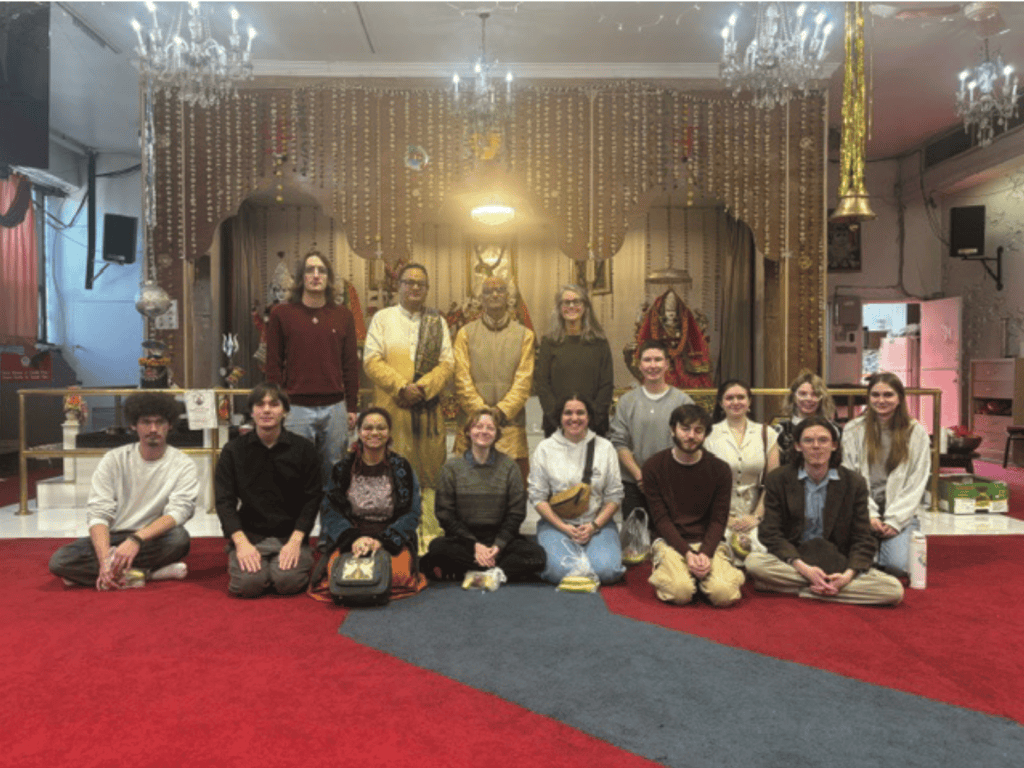
Photo courtesy of Zachary Saint Cyr
Dr. Michele Murray’s Hinduism class saw these sights, and more, on Sunday, Oct. 25, for a cultural field trip. The 12 students, of whom I am one, loaded onto a very fancy sports bus for the drive to Montreal to visit the oldest Hindu temple in Canada. Founded in 1980, the temple has been located at 995 Rue de Bellechasse for over 65 years. The moderately sized, multi-purpose building has been transformed by years of use and devoted decoration into a holy place of worship for Montreal Hindus. Paintings and depictions of Hindu deities like the elephant-headed Ganesha, god of the removal of obstacles, and the young and impish flute-playing Lord Krishna are on every wall of the main worship room. Incense wafts through the room, putting you in a specific place unlike most others you’ve been in. The speakers projecting the words of the Brahmin and the singing of practitioners are almost a little too loud, likely set at a volume suited for the most elderly attendees. The wall facing the street, with many windows, is covered with orange and red curtains, and the ceiling is covered with a criss-crossing of faux flowers on fairy lights. Even the plain white walls are interesting to look at, with large indoor bricks that have been carved with different designs scattered about. The whole space has a devoted and planned feeling to it, with everything being carefully considered in its placement and use in the space.
We arrived partway through their Sunday worship, called “puja” in Sanskrit, and stayed through to the communal lunch that’s offered afterwards. We then talked to the priests, Brahmin, and got to ask questions about Hindu practice. Dr Murray always brings her students to this temple for her Hinduism class and has been for over a decade. Cultural experiences like this are essential to the study of said cultures because, as Dr. Murray describes it, “you can read accounts of these different traditions, watch video clips, we can talk about it, but [in] actually going and immersing ourselves in these rituals we move from an observational perspective to participatory, and nothing can replace that. It adds another dimension; it gives us insight into the people. It’s something that can’t be attained in any other way, I think.”
Experiential learning opportunities like this make very different ways of life tangible and relatable in a way little else can. The visit to the temple has absolutely changed our understanding of Hinduism as a practiced thing, as student Jackson Vest says: “We had already studied puja before our visit, but nothing could have prepared us for the energy present in the room. We faced an essence that couldn’t be captured in words. Something too human to be written down. It had to be felt.”