By Piper Howell
When a childhood dream became a reality for Dr. Roberta Bondar, finally seeing Earth from space was a transformative experience. “But when you actually see it, it’s gripping,” said Dr. Bondar during her presentation, “More than two in the view”, as part of the Donald Lecture Series at Bishop’s on Sept. 14.
In January 1992, Dr. Bondar embarked on NASA’s Space Shuttle Discovery, becoming Canada’s first woman to go to space and the world’s first neurologist to go to space. In her time on board, she conducted over 40 experiments for 14 nations, covering life science, physical science, and microgravity experiments.
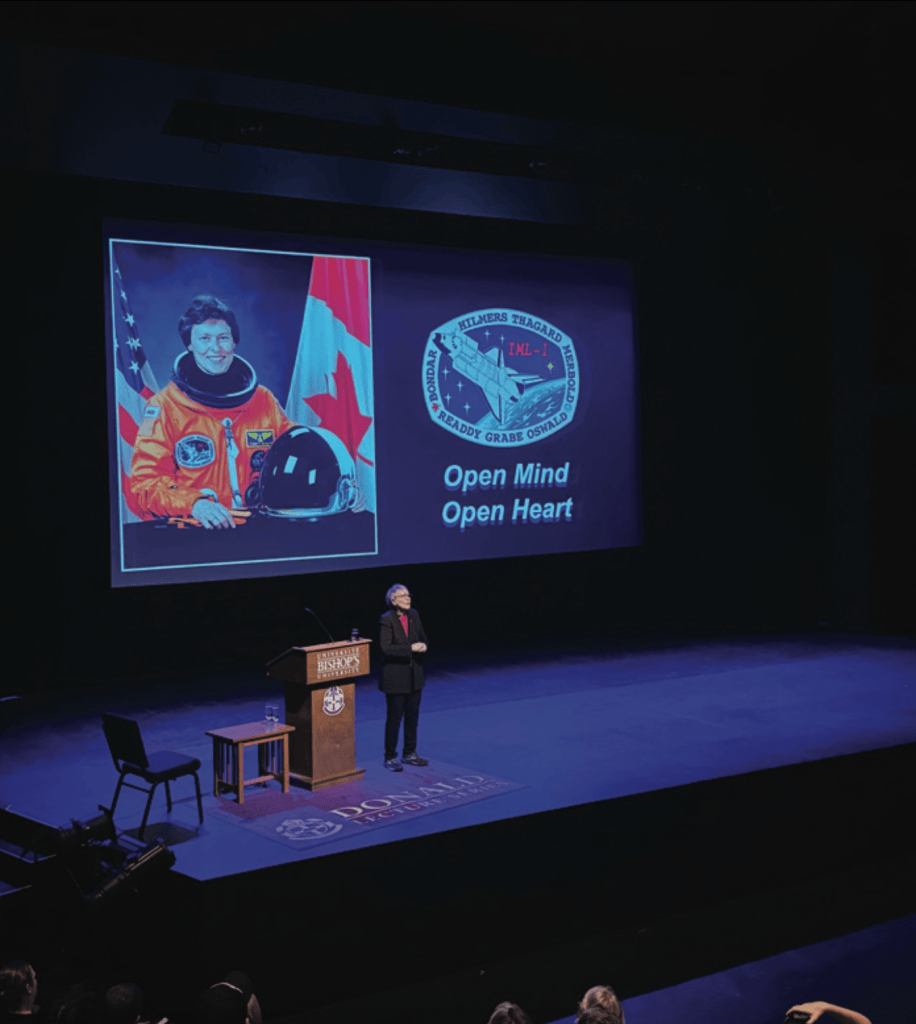
Photo courtesy of Lauren Root
Dr. Bondar’s journey did not end when she returned to Earth. As a neurologist turned professional landscape and portrait photographer, she has spent her life moving between fields of study.
Having graduated from the Royal Society of Canada’s Institute for Scientific Research in 1997, Dr. Bondar went on to pursue a career as a landscape and portrait photographer, capturing the beauty of Canada. Her work is strongly influenced by the horizon of the Earth and the edge of the planet.
For Dr. Bondar, photography became another way to explore her questions with science. “People pigeonhole me into a scientist, and now they don’t know what to do with me,” she said. Dr. Bondar stressed the link between art and science; science can help people understand the laws of nature, but photography can give them another way to see and experience it.
By helping found the Roberta Bondar Foundation, Dr. Bondar fosters the connections between photography and science. The Foundation’s seminars, workshops, and The Bondar Challenge help people, especially younger generations, connect with the natural world.
Much of Dr. Bondar’s recent work has highlighted birds and their migration patterns. During the lecture, she spoke about different species, specifically the whooping crane, lesser flamingo, Arctic tern, red knot, Sprague’s pipit and piping plover.
Dr. Bondar’s Space for Birds project focuses on how photography can help us better see nature and its wonders. The project’s second phase asks the simple question: why does avian migration seem invisible?
For Dr. Bondar, photographing birds is not only about capturing beautiful images, but also about using another lens to watch the changes taking place in the world.
While medicine, space, photography, and environmental conservation may seem different, Dr. Bondar’s lecture helped reveal how they are all interconnected by the key concept of perspective.
Going to space helped Dr. Bondar see the planet in a new way, and her photography became a way to share that perspective with others. The much-anticipated release of the Last Installment of the Saint Akzena series!
And now, through the Roberta Bondar Foundation, Dr. Bondar is encouraging people to become more observant of a world that often moves too fast.