
Piper Howell – Contributor
“History doesn’t repeat itself, but it does often rhyme,” is a quote attributed to American writer and humorist Mark Twain that I first heard in my Grade 12 history class and has stuck with me ever since. While global events such as wars, pandemics and revolutions don’t occur in the exact same way, the underlying patterns of our human behavior resurface from generation to generation, century to century. While perhaps not to the same degree, these patterns are also present in life on campus at Bishop’s, reflected in the way students engage in debates, create change and respond to challenges within the community.
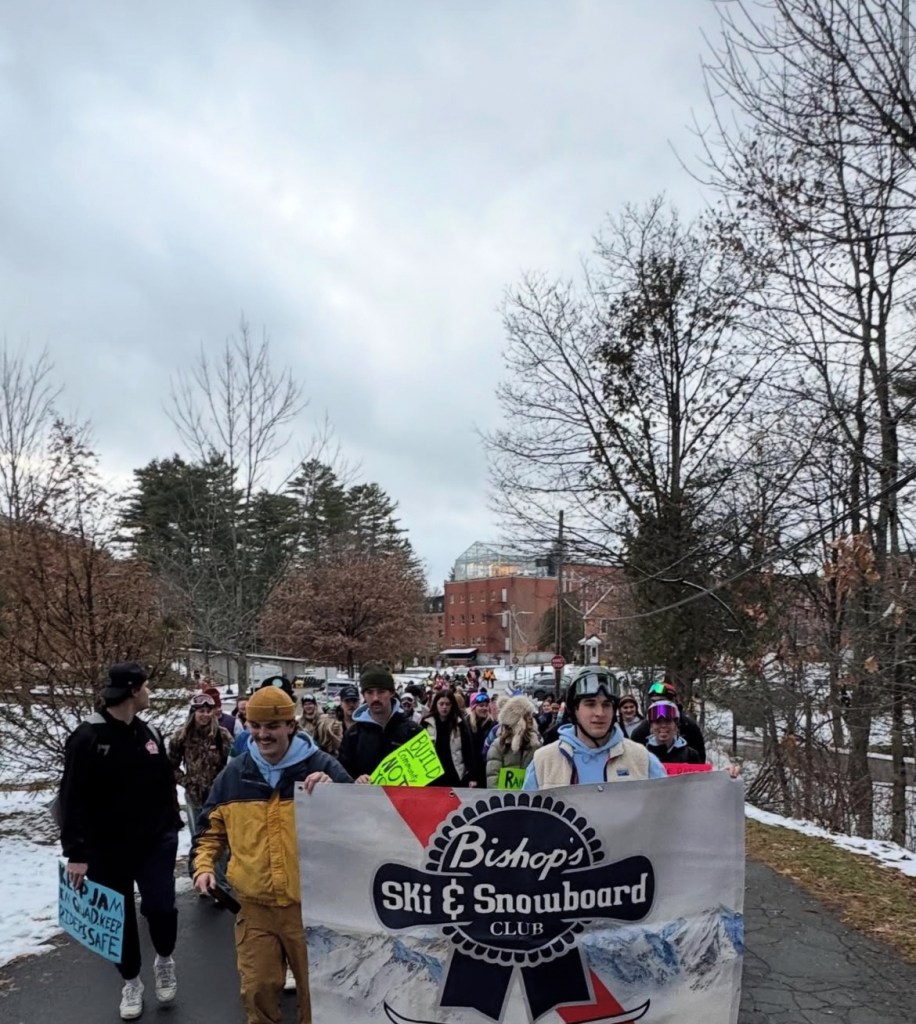
Image courtesy of BU Snow
Recognizing these patterns, or rhymes, offers a valuable perspective and can help young people better understand both the world and their place within it. Consider student activism; students globally have challenged authority and demanded change for years. The Quebec student strikes of 2012, for example, brought thousands of students to the streets to protest rising tuition fees. Even at Bishop’s more recently, the Winterfest Rail Jam protest last fall successfully pressured the administration to reinstate the event this February. While the context differs, the motivation and desire to create change remain.
Global events also leave their rhymes throughout campus. COVID-19 disrupted our routines and required students to learn virtually, echoing the challenges faced during past public health crises, such as the 1918 Spanish flu. Although these two events are separated by a century, and the world changed significantly between 1918 and 2020 (technologically, culturally and socially), the circumstances one hundred years apart were familiar: patterns of uncertainty, adaptation and resilience. They reflect the courage and capability that individuals must have shown in adjusting to constant change throughout history.
Understanding history is also crucial for academic and personal growth. Recognizing these rhymes helps us think critically, evaluate information and participate in meaningful discussions both in and outside the classroom. Learning about past political, social and environmental movements gives context to the headlines we see today. History is too often treated as a series of events with fixed start and end dates, when in reality the events of the past continue to affect the events that occur today.
Ultimately, history is not just a subject we study; it is what we constantly live through. The idea of past events rhyming with current events reminds us that the challenges we face are not entirely new but instead a part of ongoing patterns throughout history. By recognizing these patterns, we are better able to contribute meaningfully to the world around us and to shape what comes next.


 The Campus