
Jillian French – Arts and Cultures Editor
On Mar. 18, the LLC Agora hosted Naben Ruthnum as part of the Ogden Glass Lecture series, coordinated by the English department. Students and staff from the English department packed the steps of the Agora to hear Ruthnam speak on the cultural power of the immortal figure of Dracula in a lecture titled “Dracula Will Not Be Destroyed,” which touched on Bram Stoker’s famous Victorian Gothic novel, but also verged into adaptive forms of the famous literary vampire.
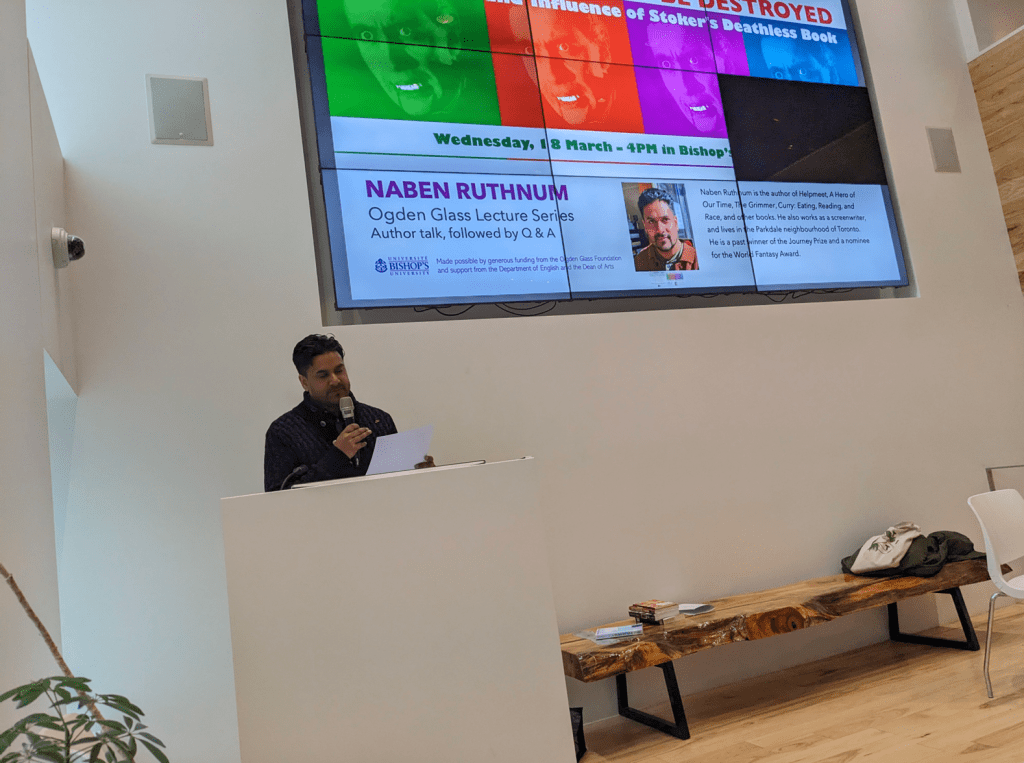
Image courtesy of Dr. Gregory Brophy
Ruthnum himself is a Canadian novelist and screenwriter who refuses to be pigeonholed to one genre: his writing spans short fiction, YA, crime fiction, memoirs and literary criticism. His current work sources material from Stoker’s “Dracula.” The novel, published 1897, tells the story of an unassuming Englishman Jonathon Harker, who becomes entrapped in the castle of a Transylvanian aristocrat, Count Dracula, whose vampirism is gradually realized by Harker. When Harker escapes, Dracula continues to haunt the narrative and prey on his friends, forcing the “Crew of Light” to pursue and vanquish the Count. “Dracula,” Ruthnum explained, is a “clumsily perfect” novel: a great work of fiction, yes, but one that includes “stark problems,” starting with the fact that none of the protagonists are half as interesting as the Count himself, and ending with the fact that even Dracula himself loses interest as “the Dracula of the last half [of the novel] is significantly less formidable than the first half.” The ending of the novel, where Dracula flees from England back to Transylvania pursued and killed by the Crew of Light, “lets down Dracula himself,” Ruthnum argues, since the arrogant, cunning Vampire of the first half would not be so easily persuaded to tuck tail and run.
Part of what makes the story so interesting, then, is the way adaptations of Dracula take the impressive figure of the count and reimagine his story in new and inventive ways, from Nosferatu (1922) to Renfield (2023). There are some Victorian classics, like, for example, Sherlock Holmes, where the many clever adaptations attempt to capture the original charm and wit of Arthur Conan Doyle’s masterful character, but Dracula is different. Adaptations don’t simply attempt to recapture the figure of the count, but revive and reinvent him from the novel’s somewhat lackluster ending. “The character doesn’t just outgrow the book,” Ruthnum points out, “he begins to rebuke it.” The nature of Dracula, as immortal and undying, is better captured in the way the Count has been adapted than it is in his own source material.
“The presentation was fantastic,” said Jon DeGooyer, a third-year film student. “Nabem has so much passion for the character which is so easily contagious.” Samiya Bouziane Merceron, a literature student, said the presentation was a great reminder of how “prevalent the character is in adaptations.”
Ruthnum’s lecture concluded with a Q&A, where he spoke a bit about his up-and-coming novel, the troubles of conclusions in horror fiction and Count Chocula. In a final question, one student asked why the tale of Dracula had become immortal. Ruthnam answered with two main points: much of it, he explains, boils down to the fascinating “loneliness of evil” of the Count, secluded and solitary in his monstrosity, though he attempts to infect the others. Even more compelling, Ruthnum admits, is that there’s something delightful about a villain who finds such joy in evil; who rebukes the morose and misunderstood nature of Frankenstein’s monster to embrace the strange monstrosity of the Victorian imagination.



 The Campus