
Sonoma Brawley – Contributor
From virtual classrooms to the vibrant stages of the Stratford Festival, Shakesperience is back exploring the importance of theatre as civic practice.
Shakesperience (ENG225/ENG466), now entering its eighth year, offers an immersive study of theatre and performance in Stratford, Ontario. This course welcomes all students from any discipline and is open to universities across Canada. Shakesperience is intergenerational by design and welcomes “students of life” who audit the course. This course offers the unique opportunity to blend academic study with behind-the-scenes access to one of Canada’s most celebrated theatre festivals, with a cohort ranging from 18 to 80.
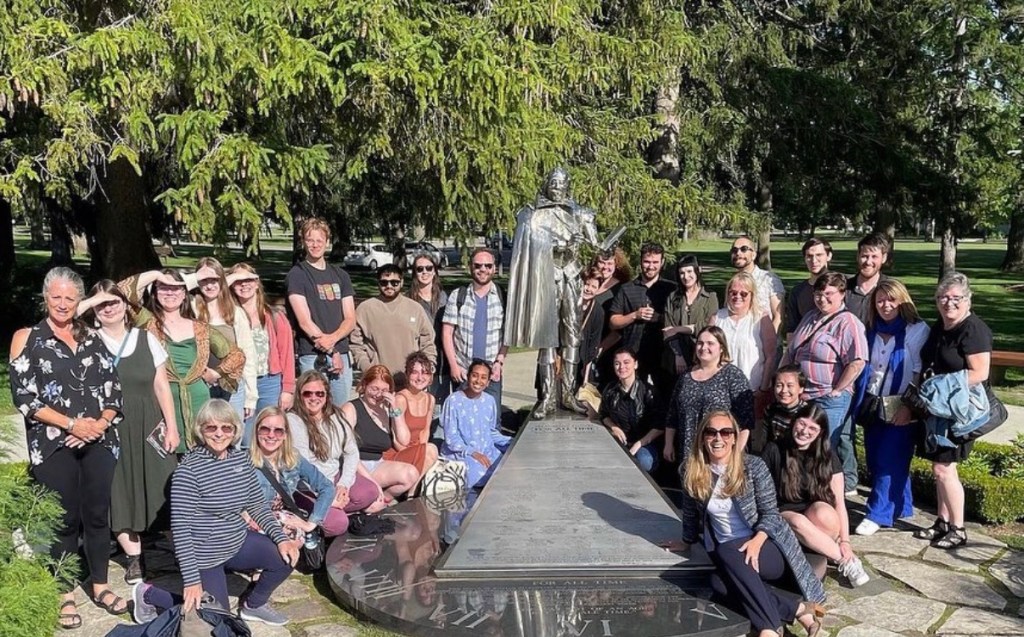
Image courtesy of Sonoma Brawley
The program starts before gathering in-person by engaging with asynchronous lectures and Zoom meetings. Then, from Jun. 29 to Jul. 4, 2026, participants will come together for a week of experiential learning in Stratford. Students will attend five productions over the course of the week: Othello, The Tempest, A Midsummer Night’s Dream, Guys & Dolls and Something Rotten! To enhance the performances, students will explore a variety of exclusive behind-the-scenes opportunities, artist conversations, immersive workshops, backstage tours and special events, including a celebratory final banquet.
Shakesperience is led by Dr. Riddell, who guides students in exploring the arts as rehearsal spaces for creating civil and just societies. Throughout the course, theatre becomes a tool for holding complexity and opening conversation. Though William Shakespeare wrote more than 400 years ago, his work remains strikingly relevant. His plays invite audiences to confront uncomfortable truths, explore moral tension and reflect on their own place within society.
That philosophy extends beyond Shakesperience, and was highlighted at the second annual Jarislowsky Shakespeare Lecture. Held in collaboration with BU Arts Fest, the panel explored the role of the arts in a civil and just society. Panelists included Shakesperience founder and Jarislowsky Chair of Undergraduate Excellence, Dr. Jessica Riddell, drama professor, Dr. Taylor Marie Graham, and Humanities Senator, myself. Throughout the discussion, the panelists examined how theatre fosters civic engagement, moral imagination and social transformation.
At this moment in time, in the age of technology, theatre provides something unique. Watching theatre, reading plays and engaging with the arts remind us how to be human. The arts highlight our humanity and offer a place of illumination where we can metabolize rupture and practice responding to the world around us. As Dr. Riddell said in the lecture, “we are seeing the dismantling of humanity” in the world around us. But, Shakespeare is still relevant today because his characters are also learning how to manage a world in “deep disrupture and change.” “Shakespeare gives us these blueprints on what it means to stay in radical humanization.”
In a world often defined by uncertainty, Shakesperience offers something rare: a chance to gather, reflect and imagine brighter futures together.
This year, there are four scholarships available to support students in attending Shakesperience valued between $1,000 and $1,500. To apply, submit a short essay to jriddell@ubishops.ca (cc rmatthews21@UBishops.ca) explaining why this experience would be transformative for you.
As participants are reminded throughout Shakesperience, the theatre belongs to everyone, and the time to engage with it is now.
Registration for Shakesperience closes Apr. 10, 2026 – for more information, visit bushakesperience.com.

 The Campus