
Megane Masson – Staff Writer
Feb. 14 constitutes a dual commemorative day: the celebration of love, but most importantly, MMIWG2S+ Awareness Day. Bishop’s Indigenous Student Support Centre (ISSC) marked the occasion by holding an outdoor vigil behind the newly inaugurated Kwigw8mna. The ceremony held on the 14th was one of two annual gatherings dedicated to MMIWG2S+ awareness.
MMIWG2S+ Awareness Day is an opportunity to honour the lives and legacies of those who have faced violence and all those missing sisters and mothers taken from their families. It serves as a space for the collective memory of Indigenous communities, not merely a focus on mourning.
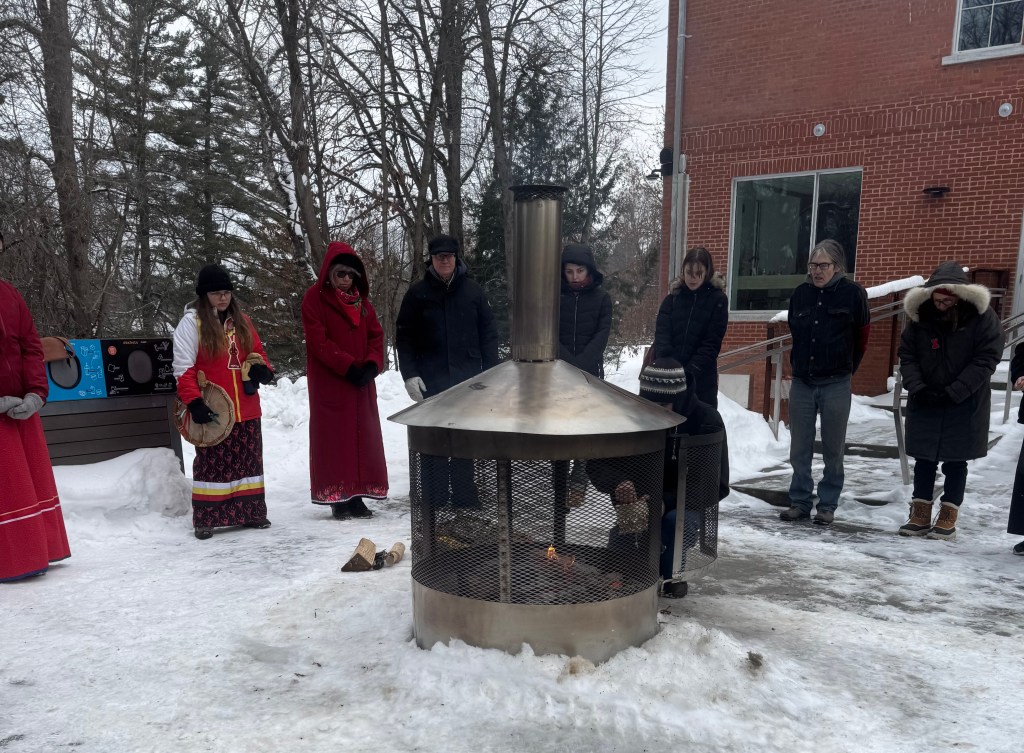
Image courtesy of Lauren Root
The vigil was held around a fire, a presence traditionally understood to facilitate connection to the spiritual realm. Vicky Boldo, Director of Indigenous Initiative & Intercultural Relations, opened the ceremony by burning sage, with the purpose of cleansing those present at the gathering. During the previous week, the ISSC had set up a tobacco tie table in the SUB, allowing students to prepare their own offerings. These offerings were later placed into the fire during Vicky’s performance of “Strong Woman.”
Indigenous students present at the ceremony seized the opportunity to share their own stories and personal experiences in relation to MMIWG2S+. This part of the ceremony was extremely powerful and showed the personal impact that MMIWG2S+ has had on Indigenous communities.
Maya, an Indigenous student from British Columbia, emphasized that the highway she lives near, Highway 16, is commonly known as the “Highway of Tears” due to the disproportionate number of Indigenous women who have gone missing along that route. According to the Canadian Femicide Observatory for Justice and Accountability (CFOJA), there has been a 27 per cent increase in victims of femicide since 2019, many of whom are Indigenous women. As of 2025, approximately 200 women and girls have been killed, and this number continues to rise.
Julie-Ann Vollant, an Inuit student from the north shore of Quebec, read a powerful poem reminding listeners that MMIW is not just an acronym, they’re family members. It’s someone’s mother, sister, daughter or aunt. A resonating statement she made was how security is a right, and that no person should be afraid of walking down the street.
The disappearance of women within Indigenous communities is so widespread that, as Brayden Hottot stated, growing up in Thunder Bay, “if there wasn’t someone going missing every month, it was considered odd.”
While the vigil could not answer why this violence persists, it ensured that those affected were neither invisible nor forgotten. Through song, storytelling, and ceremony, the gathering reaffirmed the importance of remembrance, community and accountability. The ceremony stood not only as a memorial, but as a call to acknowledge an ongoing crisis and to ensure that those lost remain present in collective memory.



 The Campus