
Journey Bardati – Contributor
The annual TheatreActiv festival just wrapped up again this year, running two alternating nights (night A and night B) in the Turner Studio theatre from Feb. 3 until Feb. 8, featuring performances ranging from short monologues to hour-long plays. During intermission, we had live music in the Turner lobby played by lovely musicians from the BU Music Society.
On Night A (Feb. 3, 5 and 7), we saw Til Skype Do Us Part, (directed by Ely-Jeanne Gauthier, stage manager and assistant directed by Tallula Russel) a futuristic drama about a failing post-death long-distance relationship using an app that allows you to skype your dead significant other; a masterful abridged rewrite of the classic absurdist play Rosencrantz and Guildenstern are Dead (directed by Emmett Tinning and Shannon Gaskarth, stage managed by Fiona Tremblay) and some interactive improv games from the BIT Improv Troupe.
On Night B (Feb. 4, 6 and 8), we saw a dramatic soliloquy taken from Henry VI (directed by Gus de Medecis and stage managed by Carson Jaacks) Beer Girl (directed by Frankie James-Brennan and stage managed by Brook Garneau), a comedy about alcohol addiction and a woman made of beer cans, as well as the culmination of one students’ honour’s project.
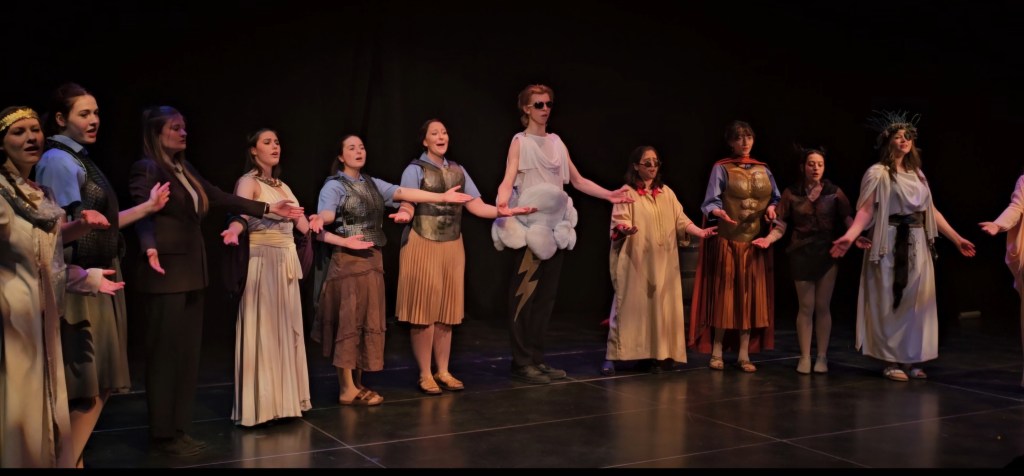
Image courtesy of Journey Bardati
I sat down with Tomas Peck, the writer, director, and composer of Diogenes and Alexandre, the musical comedy performed on Night B that explored the coincidental meeting of two distinctive historical figures in Antiquity, and his stage manager, Dale Miner.
INTERVIEWER: Could you introduce the play? How would you describe your vision, briefly?
TOMAS: I started writing this musical upwards of five years ago, after I was inspired by a variety of articles and internet bits about Diogenes. “Mr. Cynical” was the first, and from it the other songs were formed. I barely had any concept of a story really, and it sort of came forth from testing out song concepts or having fun with the lyrics – for example why not have a Blues song in here?
INTERVIEWER: How was the process of creating it? What inspired you to write about this encounter?
TOMAS: Overall, it was a very slow process. Sometimes you don’t have an inkling of inspiration, and many times I put this thing on a backburner. And often when I was inspired to write, I would completely change the script! Having the opportunity to finally put it on stage has been an interesting feeling. There is a degree of finality – you need to have a final and satisfying version of the script really – but when you are also the director for it, there are so many more things to consider and add, and you really must dig into what you’ve written. I am, however, so glad for the team I got with me; the actors, stage managers, designers and choreographers want this show to happen just as much as you, and so their ideas and discoveries are just as important to the final product!
INTERVIEWER: Dale, how has the tech side been for you? What has been the biggest challenge?
DALE: Well, it’s a musical, so there are more cues than you would expect, and we have got to coordinate our light and sound cues with live music, which is another interesting challenge. We rely on the musician to know when he’s supposed to start playing – he starts, and we plan our visual cues to him. We use follow-throughs when we can, but we don’t rely on them, instead we use sequences of “GO’s” which require the lightboard operator to know what they’re doing. Otherwise, the technical cues are no problem.
The festival as a whole turned out to be a success, due to the efforts of the cast, crew and designers who worked tirelessly and selflessly to turn a vision into reality – and the coordinators were pleased to find that the risk they took in planning six alternating nights over the usual four succeeded in attracting a breadth of audience participation.
We can’t thank those who attended enough! We hope to see you again for the 2026 New Plays Festival next fall.
 The Campus