
Anya Mullen – Opinions Editor
The fact that Catan is a popular board game is not new information. It is enjoyed by many, by Bishop’s students and way beyond, globally and among people of all ages. It has been in existence since 1995, but maybe has not been as popular until a little bit more recently. Today, everyone knows and loves Catan, and it is a go-to choice at board game nights.
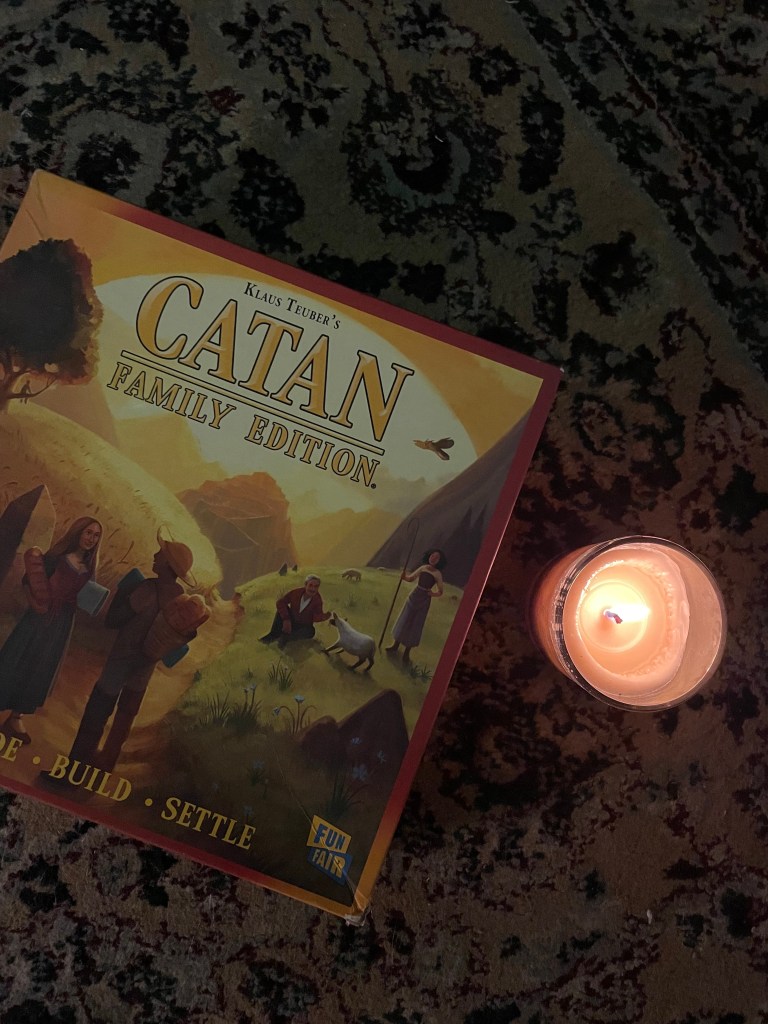
Image courtesy of Anya Mullen
However, for me personally, and maybe for many, calling it ‘Catan’ is new. Until I started playing the game with my friends at Bishop’s, I didn’t call it ‘Catan.’ In my house, it was colloquially known as ‘Settlers’ because the name of the game, as written on the box, was ‘The Settlers of Catan.’ This box holds my parents’ well-loved copy of the game, which is over 2 decades old. By extension, I have been playing the game from a young age.
When I play it here at Bishop’s with my friends, I can’t help but notice that brand-new versions of the game look very different from the one I grew up with. The rules are the same, but much of the art and even some of the cards have been altered.
In my parents’ version of the game, the drawings on every hexagon on the board and on the development and resource cards are intricately detailed and quite nice to look at. The same hexagons and cards in a new version of the game look like they were made with a computer instead of with regard for any sort of aesthetic to go with the game. The development cards that are in my parents’ game have beautiful drawings, while I wouldn’t look twice at the design on new development cards. They even changed the names of certain things, like how the now ‘knight’ was previously a ‘soldier.’
To get a little bit environmental as well, the new version of the game has plastic holders for all the resource cards. Call me old-fashioned, but what was wrong with having piles of cards directly on the table and continuing to eliminate the need for mass-produced pieces of plastic?
I’m not saying all the changes in the game are bad. My parents have such an old version of the game that the water is made up of hexagonal pieces like the resource tiles, instead of being puzzle-pieced together like the newer versions, which is indisputably more practical. But other than holding the board together with the water pieces, I don’t see the need for many of the changes that have been made to the game that I know and love.
Maybe this is all coming from a place of nostalgia for my childhood and playing The Settlers of Catan with my family at the kitchen table, but I think I also have a point that we live in a world where everything seems to be constantly modernizing and upgrading, and sometimes I think it’s nice to keep things the way they are, and not mess with a good thing.
At the same time, the changes made to Catan suggest that constant change is often necessary for something to survive. Just as the game has updated its name, artwork and components to keep up with new generations of players, people are also expected to adapt as the world around them evolves. For university students in particular, change is unavoidable. From new technologies and academic expectations to shifting career paths and uncertain futures, students are constantly being asked to adjust, improve and redefine themselves.
Much like sitting down to a newer version of a familiar board game, this constant adaptation can feel both exciting and uncomfortable. While change can lead to growth and new opportunities, it can also come with a sense of loss for what once felt familiar and stable. Holding onto an older version of The Settlers of Catan is comforting in the same way that routines and traditions can be comforting during university life. Perhaps the challenge is not rejecting change entirely, but learning how to embrace progress without losing appreciation for what came before.
Even as its design and branding evolve, Catan continues to be my choice for game nights and will remain a longtime favourite.




 The Campus