
By Josef Spence – Contributor
New Prime Minister Mark Carney, visited the Governor General Mary Simon, on Mar. 31 and asked her to dissolve parliament and call an election. The general election was announced later that afternoon. Election day has been scheduled for Monday, Apr. 28. This puts the campaigning period at just 37 days, the shortest it can be under federal regulation.
In order to vote, Canadian citizens must register with Elections Canada. Most eligible voters will already be registered, since Elections Canada usually contacts citizens when they turn 18. It is easy to check if you are registered; simply go to the Elections Canada website (elections.ca) and follow the instructions there. There are several different methods that can be used to vote. The most obvious is that of voting at the assigned polling station on election day. Polling station assignments will be mailed to all registered voters (at the address to which they are registered) by Apr. 14, but can also be checked on the Elections Canada website.
Voters can also cast their ballots on advance voting days, Apr. 18-21, at their assigned polling stations, which can be found the same way as election-day polling stations. Early votes can be cast at any Elections Canada office across the country. The last main method for voting is by mail. Voters interested in this means of voting must register to do so before Apr. 22. They will be sent a ballot which they must return either to their local Elections Canada office or through mail. When voting in person or when applying to vote by mail, voters will be required to present some form of identification with their photo, address and name, such as their driver’s license, to confirm their identity and that they are registered.
In this election there are four main parties competing for seats in parliament and three leaders of those parties competing to be Prime Minister. The Liberal Party of Canada is led by Mark Carney, the current Prime Minister and recent successor to Justin Trudeau. The Liberals have positioned themselves as a party with experience in dealing with Trump and U.S. tariffs in recent years, and are stressing Carney’s long and considerable experience as an economist and banker as qualification for leading Canada through economic turbulence.
The Conservative Party of Canada (CPC), led by Pierre Poilievre, has adopted a policy platform of economic integration across Canada, especially by removing inter-provincial trade barriers, and major tax cuts for middle- and low-income households. The CPC stresses the need to expand Canada’s markets and the ability to transport goods across Canada to those markets outside of the U.S.
Jagmeet Singh leads the New Democratic Party (NDP). The NDP stresses the need to expand social services as Canada enters a trade war to ensure everyone is supported. Both the Liberals and NDP have suggested raising taxes in order to fund various projects.
Yves-François Blanchet leads the Bloc Québécois, focusing on defending the sovereignty and interests of Quebec in negotiations with the U.S.
The Green Party of Canada, the People’s Party of Canada, and some independent candidates are also running candidates in some electoral districts. Voters can easily check all of the candidates running in their specific electoral district on the Elections Canada website. Information on what individual candidates believe in or plan on doing can often be found in local media releases, such as local papers or local radio stations, or on party websites.

There have already arisen some controversies in the campaign. A Liberal candidate in Markham, ON, has stepped down from the race after advising people to turn his Conservative opponent into the Chinese consulate to collect a bounty that the Chinese government has placed on that candidate’s head for promoting democracy and free expression. Notably, Carney and the Liberal Party have yet to address this incident. On the other side of the aisle, a CSIS (Canada’s intelligence agency) agent recently leaked to the Globe and Mail that there was likely interference by the Indian government in the Conservative leadership elections in 2022 that made Poilievre leader. Nothing in the report suggests that Poilievre or anyone on his team were aware of this interference, and the report suggests that the interference had no effect on the outcome of the leadership race.
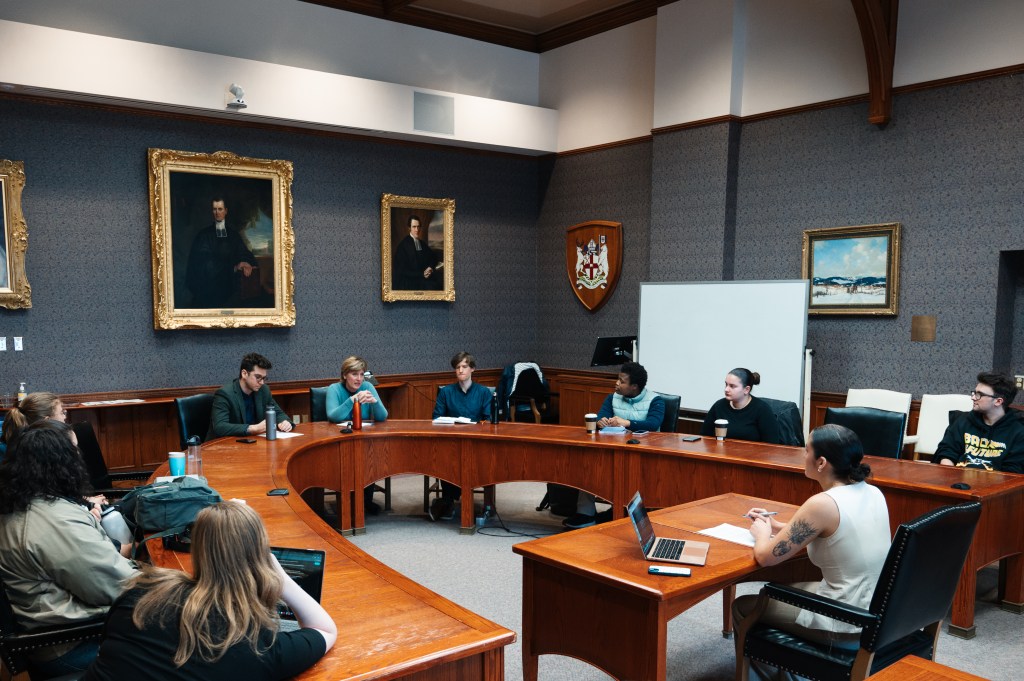
In order to better inform students about the election, the Politics and International Studies Association held a Canadian Federal Election Panel on Mar. 31 in McGreer 100. This panel consisted of Dr. Jacob Robbins-Kanter of Bishop’s Politics and International Studies department, Dr. Jean-François Daoust of the School of Applied Politics at the Université de Sherbrooke, and the Honourable Marie-Claude Bibeau, Member of Parliament for Compton–Stanstead.
There was a broad appreciation for the panel, and students seemed to find it quite informative. One student, Eva Rachert, commented that she “especially appreciated the breadth of perspectives provided by the speakers” as they analyzed the platforms of the parties and predicted their effects on both a short- and long-term scale. Dr. Robbins-Kanter similarly noted that “it’s nice to bring in experts from outside of Bishop’s”, but recognized that it would be better if Canadians focused a little more on “what’s going on here in our own backyard” than on the affairs of other countries, especially the U.S. So, as the election comes closer, there is much for Bishop’s students to watch in the arena of Canadian politics.



 The Campus