
By Jillian French – News Editor
On Friday, March 21, Qajaq Robinson took to Centennial stage to share her journey as a former commissioner for the national inquiry into Missing and Murdered Indigenous Women and Girls (MMIWG). The final Donald Lecture of the year followed the opening ceremony of Kwigw8mna, the newly renovated campus building which fosters a space for Indigenous students to gather, learn and find support. Robinson’s lecture offered solemn insight into the systemic injustices faced by Indigenous people (particularly women and girls) and a thoughtful reflection on how to move forward using Indigenous tradition, knowledge and strength.
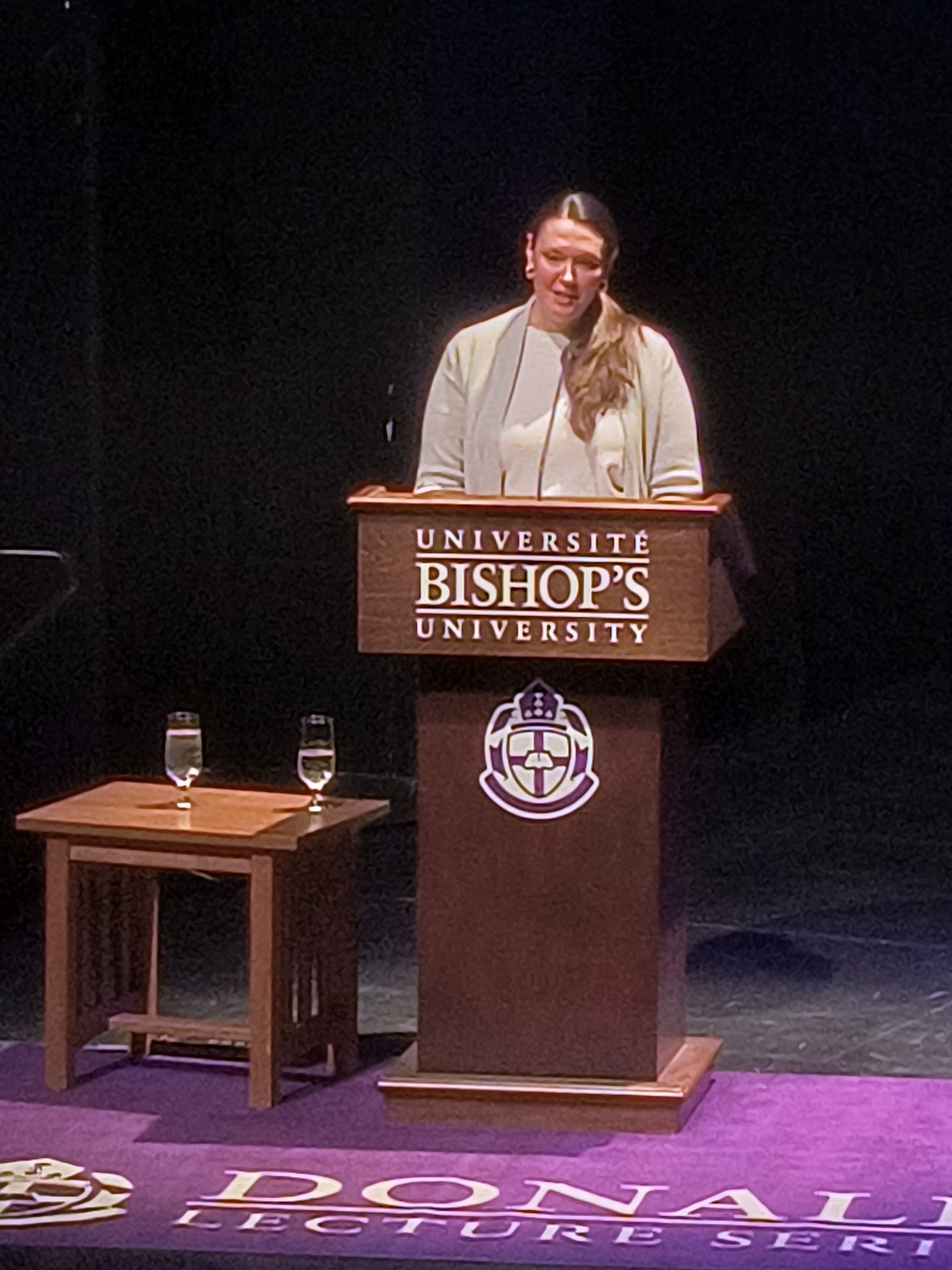
Robinson is a Bishop’s alumna (‘95) and lawyer from Baffin Island, Nunavut. She is non-Indigenous, but grew up in an Inuit community and speaks Inuktitut fluently. She told the audience that she was initially named Evelyn until an Inuit elder told her parents her name should instead be Qajac, after an Inuit community member who worked with the RCMP. This name, she explained, catalyzed the way she was “welcomed in the community” and also “played a big role in what I have done with my life.” From 2015 to 2019, Robinson served as one of four commissioners for the national inquiry into Missing and Murdered Indigenous Women and Girls.
Indigenous women continue to experience disproportionate rates of targeted violence in Canada, including sexual abuse, sex trafficking, homicide and disappearances cases. Indigenous women were up to six times more likely to be murdered than non-Indigenous women from 2001 to 2015. The inquiry, Robinson added, “was a result of years and years of grassroots movements from Indigenous women, who for years watched their sisters murdered and disappeared in plain sight.”
After decades of being ignored and dismissed, the movements gained traction leading up to the 2015 Canadian federal election, when candidate Justin Trudeau made an election promise to form an official inquiry. He upheld his promise once he took office, and the commission was formed. The task, according to Robinson, was to “investigate systemic causes of all types of violence, and the particular vulnerability of Indigenous women and girls in Canada, as well as what actions could be taken to remove these systemic injustices”. It was, as Robinson described, “a tremendously monumental task”.
One key consideration, Robinson illuminated, was making sure the process was trauma-informed, sensitive to affected families, and “centred on Indigenous ways of knowing and doing across Canada”. To achieve these goals, Indigenous elders were assigned to each commissioner to advise and support the process. The commission held “truth gatherings” — not “inquisitions” or “hearings” — in Indigenous communities, where they worked collaboratively to create safe spaces to talk with the community about MMIWG. The process of the investigation, Robinson explained, was just as important as the report. “It had to touch people’s hearts, people’s souls. And it had to mobilize, so that in these communities, it lived on and got a true foothold.”
Robinson also emphasized the inquiry’s rights-based approach to the crisis. “Violence and lack of security is fundamentally a human rights issue”, she said. The commission was tasked to consider “whether Canada was upholding those rights.” In the course of the inquiry, she added, they found that the repeated and systemic violations of Indigenous women’s rights was “a product of the country we built… this was not an accident, this was by design.”
“It became very clear to us that this amounted to genocide,” Robinson told the audience. The process of reconciliation, then, must “amount efforts that match or surpass the efforts to eradicate Indigenous peoples,” she added. Our ideas of reconciliation as settlers, though “are often predicated on the idea that we know what’s best. That will never work.” The commission, which produced it’s final report in 2019, outlines several principles for change: promoting Indigenous knowledge, self governance and solutions were key principles for centering Indigenous agency in the reconciliation process. “Apologies don’t cut it”, Robinson said. Our goal is to obtain substantive and tangible equality through an Indigenous lens.
While the opening of Kwigw8mna represents a celebration of Indigenous knowledge and culture here at Bishop’s, Robinson encourages students to never forget the long journey and hard battles Indigenous peoples have fought to get to this moment, and to consider the work that still remains. “No one is left without a job to do”, she says. With the upcoming Canadian federal election, she encourages students not to let scare tactics and threats from America distract us from political commitments to Indigenous communities. Robinson concluded, “Don’t let them forget”.

 The Campus