
By Lauren Root – Staff Writer
As the end of the school year approaches rapidly, Bishop’s Research Week brought warm weather, excitement, and anticipation. The week-long event, held from March 17 to 20 was organized by Joannie St. Germain, with the Office of Research and Graduate Studies, and brought together undergraduate and graduate students, as well as professors and guest speakers.
Throughout the week, professors and guest speakers spoke on a variety of topics across campus. The Gait and Centennial theatres were packed with events, hosting crowds of students and faculty who were eager to learn. Listeners were able to gather for coffee and refreshments in the Gait while listening to 30-minute-long talks, and often entire classes would be present to learn about specific topics. Something very special about this year’s Research Week is that guest speakers came from a variety of different backgrounds and not exclusively academics/scholarship.
On March 17, Dr. Tim Haltigin presented a presentation called Asteroids, Lasers, and Cookies: Canada’s role on the Osiris-REx mission. Dr. Haltigin is a geomorphologist, studying landscapes. Since 2016 and the launch of the Osiris-Rex spacecraft, he has been managing the Canadian laser instrument that will be mapping out the asteroid to find the best place to retrieve a sample before returning to Earth. After its launch in 2016, Osiris-REx set out with the objective of collecting a sample from an asteroid named Bennu, a successful mission, and later returned to Earth in 2023. Dr. Haltigin spoke about following one’s passion in their profession and the possibilities of working in space.
Dr. Arthur B. McDonald presented his talk titled, Understanding the Universe from 2km Down to an eager crowd in Centennial Theatre on March 17. Dr. McDonald is a Nobel Prize winner and the director of the Sudbury Neutrino Observatory (SNO), which is located 2.1 km underground in Sudbury Ontario’s meteorite crater, a necessary step to eliminate radioactivity from cosmic rays. In this observatory, they use heavy water (D₂O) to capture neutrinos from the sun, which penetrate the ground. His team’s research into Tau neutrinos and Muon neutrinos discovered that neutrinos oscillate and have mass, a groundbreaking discovery in particle physics and results which required changes to the Standard Model of Elementary Particles.
Lysandre Leduc Boudreau, a documentary filmmaker and researcher gave a fascinating talk in the Gait on March 19th, where she spoke at length about the conditions required for filming documentaries. She also spoke on the various roles found in the film industry, including researching locations and characters for documentaries. She’s received numerous awards for her first feature-length film, Jacques, which is a portrait of a pioneer in Nordic expeditions living in northern Quebec.
Marc-Antoine Kelertas, an actor and director, spoke in the Gait on March 19 to a crowd of drama students. Leading an extremely interactive presentation, Kelertas shared the in-depth research that actors must do before taking on characters and projects. He spoke of the struggles of using real emotion in a fictional sense and facing innermost thoughts while preparing for a role.
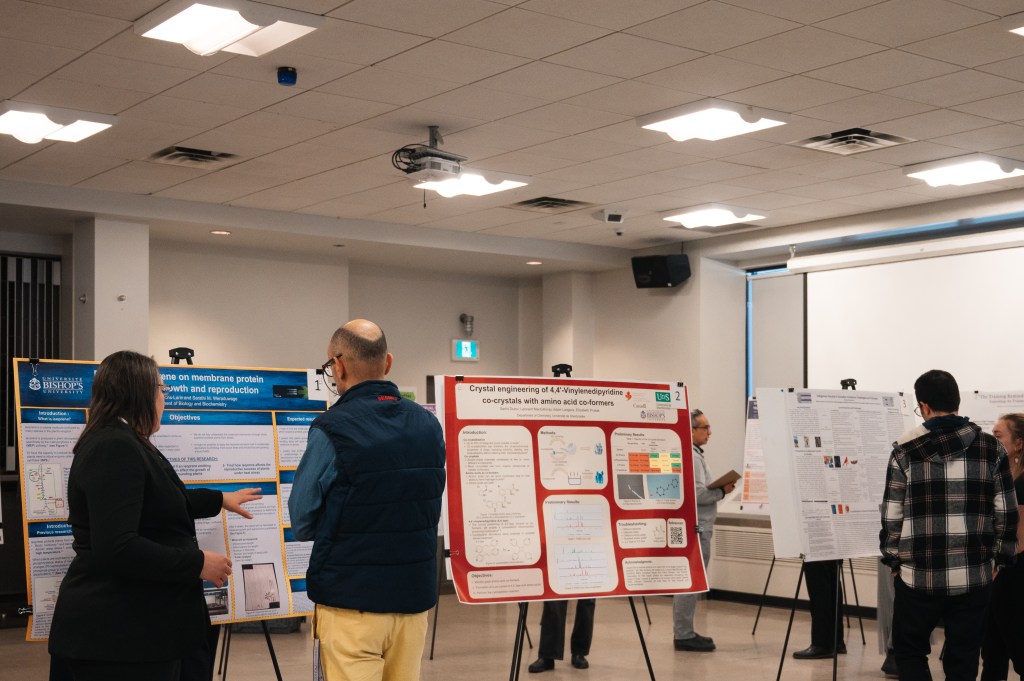
Research Week presented not only guest speakers with the chance to share their passions and professions, it also showcased many undergraduate and graduate student projects. Fifth-year Kate Thompson presented her honours research, Exploring the potential effects of female reproductive factors on fitness adaptations and training loads in university soccer players, which won best poster in Undergraduate: Social Sciences.
As a member of the women’s soccer team and a sports studies major, Kate is interested in the relationship between female reproductive factors, such as the menstrual cycle, and player performance. The project assessed the impact of oral contraceptives on low energy, training load, and fitness over the competitive season. This study has helped predict and prevent injuries on the women’s soccer team.
When asked about how she felt heading into her presentation, Kate stated: “I was definitely nervous at first,” going on to say, “But this is something I’ve been learning about for months and personally care a lot about, so that passion helped me stay confident.” Kate enjoyed seeing her study capture interest: “Seeing everyone around so curious and engaged made the experience even more meaningful!”
Research Week 2025 was extremely busy but brought plenty of guest speakers and new information to Bishop’s, which made the week enjoyable and educational. Congratulations to all of the students who presented their projects, your hard work is noticed and appreciated!

 The Campus