
By Alys-Ann Suprenant Coache – Contributor
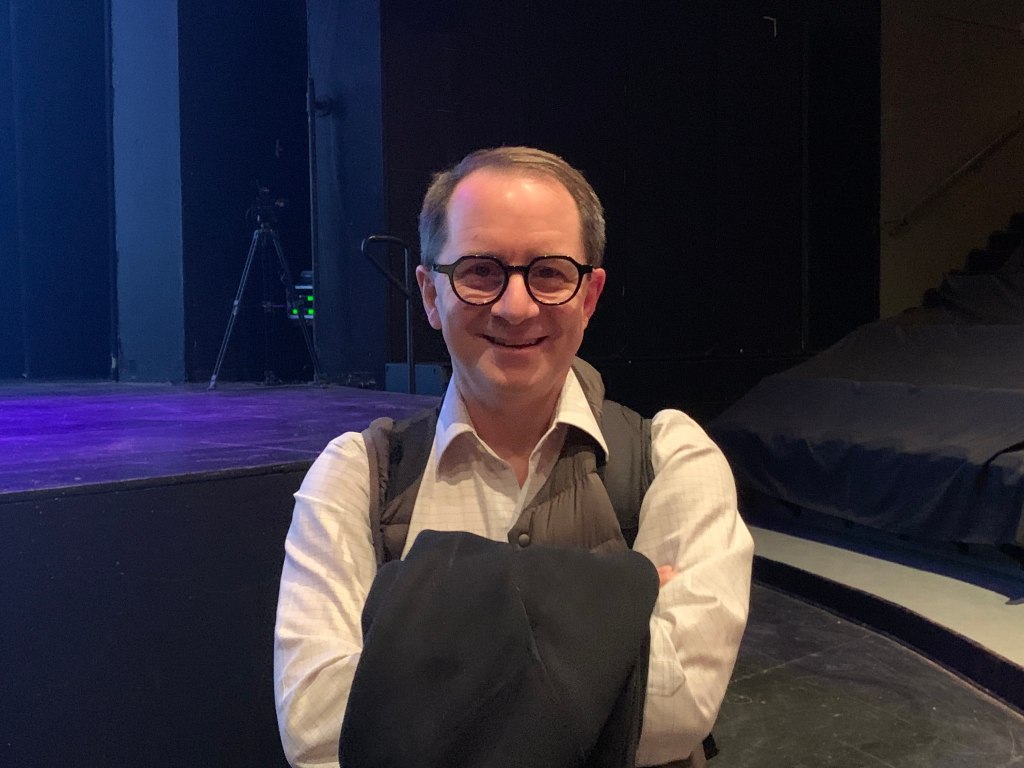
What if, to unlock some of the universe’s best-kept secrets, we had to turn away from the sky and dig two kilometers underground? Well, that is exactly the project that Dr. Serge Charlebois is working on, and we had the chance to learn about the design and implications of such a project directly from him in a speaker event at Bishop’s on Friday, March 14. Dr. Charlebois is currently a professor at the Université de Sherbrooke, where he also conducts research in solid-state physics. He works on projects like the detection of neutrinos and dark matter, which are also key areas of focus for Dr. Arthur B. McDonald, who guest-spoke on the subject on March 17 for Bishop’s Research Week.
Firstly, dark matter and neutrinos are two elusive components of our universe that physicists are actively trying to understand. Dark matter is an invisible form of matter that does not emit, absorb, or reflect light in any way. That means we can’t observe them directly with a telescope, for example. Meanwhile, neutrinos are nearly massless, neutral particles that barely interact with matter, yet they are produced in vast quantities by stars and supernovae. Detecting these elusive particles is the challenge at hand, and it requires very sensitive equipment.
This is where noble liquids come into play. These dense, stable elements emit faint ultraviolet (UV) light when a particle collides with a nucleus inside them. To record those very weak emissions, the experiments rely on semiconductor light detectors, which can count individual photons with great precision. By using these principles, researchers aim to identify both dark matter interactions and rare neutrino events, helping to uncover some of the universe’s greatest mysteries.
So, what is solid-state physics and how does it come into play? Solid-state physics studies physical properties of solid materials to understand how atoms interact. Applications of solid-state physics include semiconductors, sensors, and detectors. Dr. Charlebois’ research revolves around designing and building such instruments to detect the UV glow emitted by noble liquids.
His work contributes to two major projects: the search for neutrinoless double beta decay in xenon, and the detection of dark matter interactions in argon. They both require extremely small and precise detectors that can count photons one by one.
These projects present numerous challenges. Both aim to detect extremely rare events, so scientists must observe very large volumes of noble liquids over extended periods of time. Additionally, both experiments induce background noise from other interactions and events. To reduce this interference, the use of ultra-pure liquids and exceptional energy resolution is necessary. However, better light detectors are bulkier and can’t work at the cryogenic temperatures required for noble liquids, unless accommodations are made. This is why Dr. Charlebois is working on improving smaller photodetectors called silicon photomultipliers (SiPMs).
As of now, the aforementioned experiments have yet to detect their sought-after signals; neither neutrinoless double beta decay nor dark matter interactions have been confirmed. That doesn’t mean the detectors have remained silent, but rather that every reading they had could be explained by known physics. Every event has its specific energy signature, and no unexpected signals have been observed so far.
These experiments are crucial in particle physics. Currently, dark matter is a strong theoretical construct, but confirming its existence would solidify numerous theories about how galaxies remain gravitationally bound and what the universe is made of. Similarly, if we get results with the neutrinoless double beta decay experiment, that will teach us about the nature of neutrinos, a very mysterious particle.
We talk about these universe-size dreams of knowledge advancements but, to paraphrase a statement of Dr. Charlebois: Even if you dream of decrypting the galaxies, remember that you first have to turn around and arrange atoms on a plate.



 The Campus