
By Abby Epstien – Arts & Culture Editor
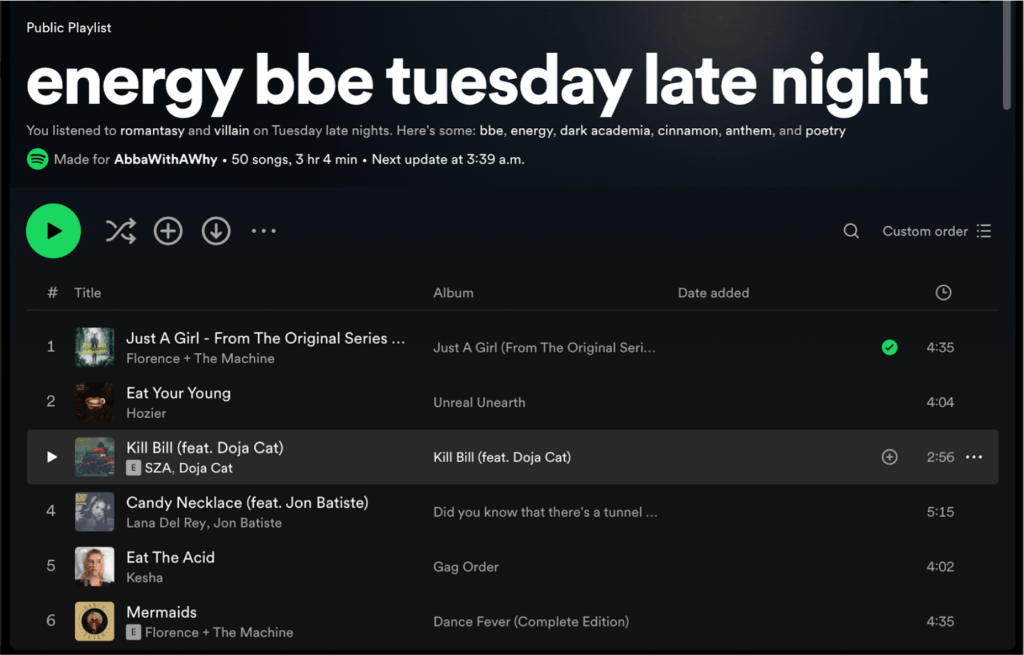
Photo courtesy of Abby Epstein
It’s a Tuesday evening and I am about to embark on a momentous – last minute – task that I would have done earlier had my exhaustion not encouraged me into an extended slumber beginning at 5pm. In any case, I am here, where I have been before, in front of my laptop opened to Spotify, attempting to find the means to revive myself. Evidently, Spotify is aware.
Launched in September 2024, Spotify’s ‘Daylists’ curate a playlist inspired by our listening habits per the given time and day, aided by the frighteningly on-the-nose algorithm that seems to read the minds – and subconsciousness – of users. It works to establish a strong phatic connection and cultivate a conative identity as much as it itself is informed by it.
Just as music is informed by the human experience, sonic and lyrical power motivates people in immeasurable ways, tuning into the depth of human emotion. When Spotify presents me with a 50 song collection tailored to my typical Tuesday evening activities and aspirations (“energy bbe* tuesday late night”) I immediately feel seen. My Daylist identifies “romantasy” and “villain” as the vibe of the soundtrack suited to my situation – a kind of romanticisation of procrastination, myself the hero against the evils of time mismanagement. Moreover, this music will give me the energy to achieve my goal. The keywords highlighted in the subtitle make further suggestions that I can connect to connotatively: “dark academia” (an aesthetic category inspired by immersion in classical education settings – think Dead Poets Society), “cinnamon” (warmth, comfort, and coziness that comes after finishing assignments), “anthem” (empowering and repeatable to reinforce a sense of confidence and identity in myself), and “poetry” (music with a focus on lyricism to reveal the interiority of a person, and perhaps enable one’s creativity with words) are all ideas which coincide with me accomplishing my task. These form an identity of someone who through a stroke of last minute genius, will complete a work of quality – a rather masterful construction of the conative function.
Equally, however, Spotify must prove that the daylist is effective and make sure I stay listening. First on the list is “I’m Just A Girl,” by Florence and the Machine, a song that I’ve played at least once a day for the past two weeks including last Tuesday night on repeat. The second song, “Eat Your Young,” by Hozier, was released a year ago. I love Hozier and have listened to the song passively a few times; more notably, his most recent release “Too Sweet” has been playing on a loop and so I am interested in relooking at Hozier’s past work as a result. “Kill Bill,” by SZA is immensely popular and lyrically intense, but with a chill sound. I can immediately connect to the song’s familiarity, even though I don’t play it often through my personal account. I haven’t listened to “Candy Necklace,” but I am a fan of Lana Del Rey’s music, and the same goes for “Mermaids,” by Florence and the Machine. “Eat the Acid,” by Kesha is a bit of a wildcard, but at this point, I trust Spotify to know the right songs for me tonight and I can see myself in the curation of titles. It is a deeply phatic tactic that is employed.
Through the assignment of niche labels and a carefully selected list, Spotify is able to deliver exactly what its users want by also showing us what it wants us to want. In an age of vast commercialism, a sense of authenticity has dwindled amongst the artistic community in favour of mass-marketable appeal. Rather than having the responsibility of authenticity be in the hands of individual artists, Spotify assumes that position. Daylists are a curation of taste, designed to appeal to a specific name for a wide mood. A distinct artistic brand is therefore unnecessary and commercially, everybody wins. Yet, a loss of authenticity is still a concrete danger: a semblance of a vibe is not a true replacement for the singularity of art to reveal the depth of humanity. To that, Spotify’s daylist is merely a blanket.
*bad bitch energy

 The Campus