
By Tallula Russell – Contributor
Ed Shirley’s talk “From There to Here and Still Further to Go: Dialoguing on Racism to Build a Better World for All” illuminated minds on Feb. 11. History professor Gordon Barker organized the talk in conjunction with Bishop’s Black History Month activities.
Ed Shirley is a behaviour and crisis intervention consultant working in Toronto. His anecdotal talk served to highlight the struggles and discrimination faced by Black people living in Canada today. He discussed his immigration to Canada from Jamaica when he was ten in 1973, his time as a football player with Concordia University in the 80s, as well as some anecdotes of discrimination he’s experienced in his field of work within the last month.
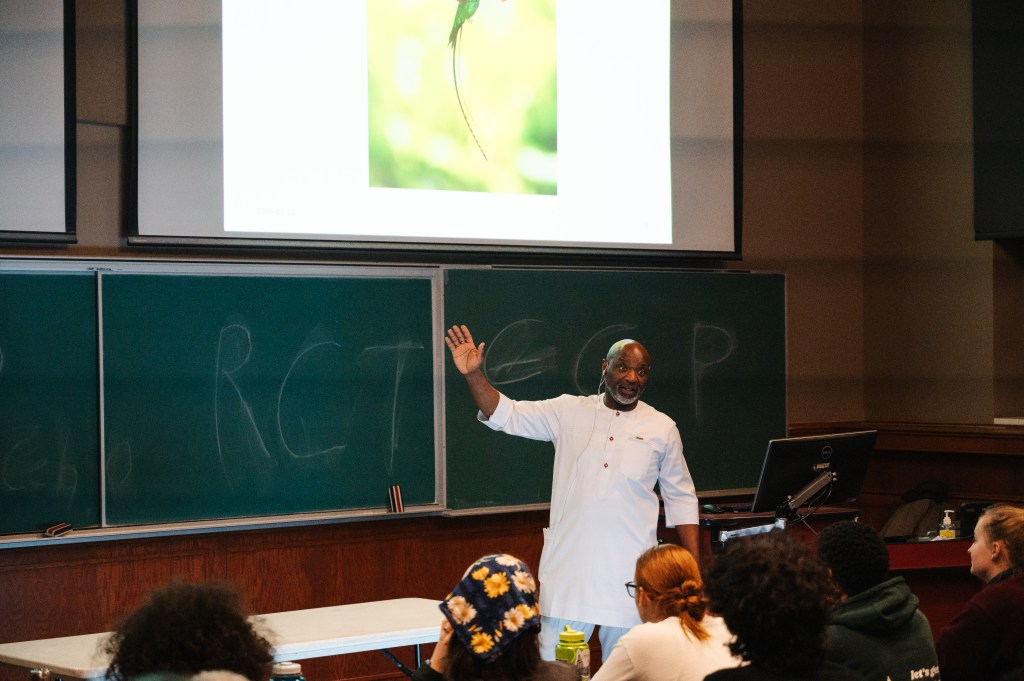
Shirley’s description of his experience immigrating to Canada was enlightening. He spoke a Jamaican dialect of English and had to overcome a language barrier in conjunction with the cultural barrier of coming to live in a city in Canada and the racial barrier of a racist society. He noted the feeling of being the only one in the room that looked like him for the first time. Discomfort and alienation could be felt across the hall. He discussed his experiences with bullying and how when he was beaten so severely that his retina was detached, his school did nothing to reprimand his assailants, who were fellow students.
Shirley found solace, community and identity with his local community center, the Harriet Tubman Community Organization. Shirley found a connection with other Jamaicans and Black immigrants through the organization, especially through cultural dance. Shirley also excelled in sports, which he pursued into adulthood. “I was going to be untouchable in a different way,” he said. Due to his dedication to football, he was scouted by both Bishop’s and Concordia. He chose Concordia, in large part because there were other Black athletes.
While living in Montreal, Shirley was denied service at a pub during an excursion with his teammates. The teammates whom the pub agreed to serve ordered drinks, took one sip, and the whole team walked out without paying. This particular story exemplifies the very-much-alive racism in Canada. The Canadian Charter of Rights and Freedoms was enshrined into law in 1982, only 43 years ago. This made racial discrimination like refusing service illegal across Canada. The enshrinement of this law on a federal level comes 17 years after the 1965 “Civil Rights Act” was passed in the United States.
Shirley concluded his talk with his most recent interaction with racial prejudice, working with a teenager in crisis this past January, who called him the N-word repeatedly. Shirley said that he wasn’t bothered by the word, but rather by wondering “Where did he learn that from?” Addressing his experience of Blackness in a white-dominated, Shirley added “I don’t want to assimilate; I want to integrate.”




 The Campus