
By Josef Spence – Contributor
Sitting across the table from me at Dewies, one of my friends posed the question: what is the best direction?
Of course, the correct answer to this question is “east,” although someone else at the table proposed “west” and another “north.” Actually, one of the people at the table went so far from the correct answer, as to assert the preposterous idea that “northwest” was the best direction. It was truly absurd.
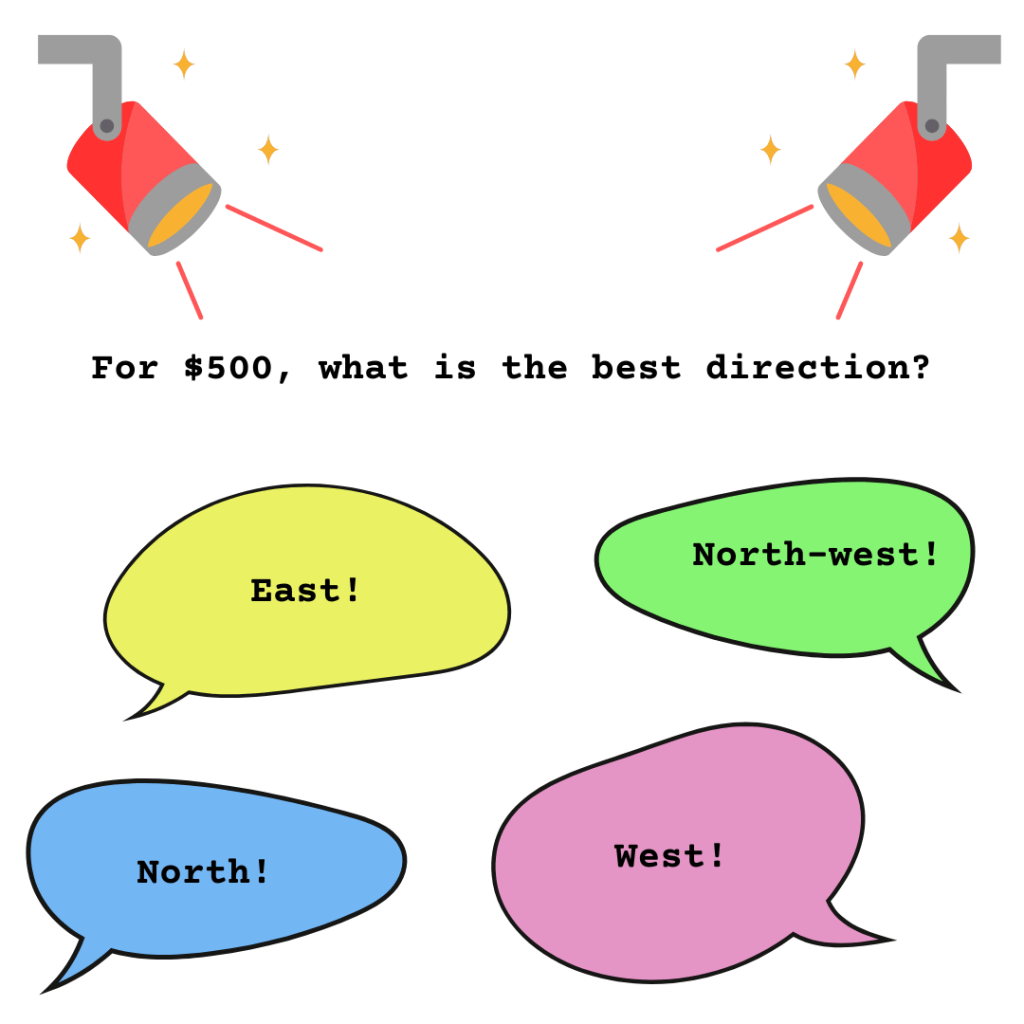
Was it strange that this topic sparked such a heated discussion? Or that we each proudly claimed to know the ‘best’ direction? Or that we declared our answers with such certainty, even though most of us only thought of defenses afterward? I believe it was a mix of all these things.
However, intermingled with the absurdity, pride and hubris that underlies our assertions is a fundamental desire to know the normative truth of the matter. In wildly proclaiming our opinions on the best direction, we are, most basically, making propositions about the true normative conditions of directionality. Then in engaging in lively debate about those propositions, we produce conditions for determining what is actually the truth of the matter. Believe it or not, this is true about all arbitrary opinions that we have, not just the best direction, including opinions such as the best colour, the best number, and whether dogs or cats are preferable, and all other seemingly pointless debates that arise from the discussion of them.
This is one of the most important parts of being a student, and perhaps a defining feature of humanity: the desire to seek the truth of matters and, perhaps especially or particularly, the desire to know the normative — or perhaps “ethical” would be a better way of putting it — state of nature, or the world.
The pursuit of knowledge I think is fundamentally rooted in the desire to discover and engage with the truth of matters, and what is more central to being a student than the pursuit of knowledge? Nothing, except perhaps even more particularly the pursuit of knowledge of humanity — of which a core tenant is the normative framework of the world. Yet even in pursuing knowledge of the physical world through the natural sciences students are bound within a normative framework. That is why research ethics boards exist.
In debating such seemingly arbitrary opinions as the best direction, and it may, in fact be that the truth of the matter is inconsequential, there is revealed a human desire to know normatively. While many people have proposed that people only really need or even should only know things empirically, our pursuit of normativity in casual discussion betrays a different matter of fact.
So even in something as seemingly pointless and ridiculous as discussions or debates about seemingly arbitrary opinions, there is great importance in its illustration of human desire and pursuit. Furthermore, such debates help people gain an appreciation for, and practice in debates of normativity that can then be applied to the truly pressing ethical questions of our age.
Lest people mistake arbitrary opinions and debate about them as useless, let them consider the importance of those debates for human formation and public attitudes.




 The Campus