
By Olivia Norby – Senior Copy Editor
Bishop’s University hosted an unforgettable evening on Friday, Jan. 17, 2025, as part of the 2025 Annual Jarislowsky Shakespeare Lecture. The Gait buzzed with excitement, as the event brought together the vibrant community of students, faculty, and guests for a panel discussion that explored Shakespeare’s continued relevance in building creative futures.
The event featured a dynamic conversation between Dr. Jessica Riddell (Jarislowsky Chair of Undergraduate Teaching Excellence), André Sills (award-winning actor and director) and Sonoma Brawley (Humanities Student Representative). The evening provided a unique space to engage with the timelessness of Shakespeare’s works and their potential to inspire change in today’s world.
With ambient lighting and a welcoming atmosphere, the event set the perfect stage for meaningful dialogue and connection. Dr. Jessica Riddell, who kicked off the evening’s discussions, reminded the audience that “the best learning happens outside of the classroom.” The event was a celebration of creativity and intellectual exchange, allowing attendees to immerse themselves in a conversation that spanned generations and disciplines.
One of the key highlights of the evening was André Sills’ reflection on his journey as a Canadian actor and director, now entering his 11th season at the Stratford Festival. Sills, who is set to appear in Macbeth and The Winter’s Tale in 2025, shared his personal story of discovering Shakespeare and its transformative effect on his career.
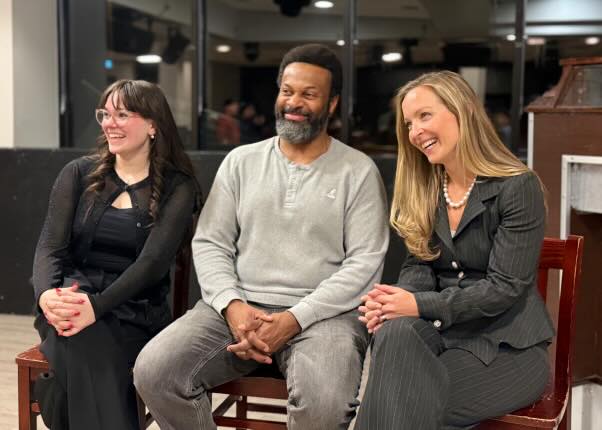
Sills spoke passionately about how Shakespeare’s works offer profound insights into human nature. “Shakespeare does a good job of revealing humanity, a good investigation into humans opposed to seeing the world in black and white,” he explained. “If you can do Shakespeare, you can do anything.” His reflections emphasized the lasting impact of Shakespeare’s plays on actors and audiences alike.
Sonoma Brawley, a third-year student at Bishop’s University recalled her first encounter with Shakespeare and how it shaped her future. Initially overwhelmed by Twelfth Night, Brawley soon found herself captivated by the depth and humanity embedded in Shakespeare’s world. “The world built and unfolded in front of me, and it felt real and human,” she recalled.
Now serving as Student Representative, Brawley has become a dedicated advocate for arts education at Bishop’s University. “There’s so much complexity in Shakespeare’s work that highlights our humanity and the contexts of our society,” she shared, reflecting on how the playwright’s exploration of human nature continues to resonate in today’s world.
Dr. Jessica Riddell emphasized how the arts—especially Shakespeare’s work—can serve as a vehicle for transformation in both education and society. She reflected on her own journey, which had taken an unexpected turn after she left McGill University’s medical anthropology program and later found her calling in literature. “Where’s my Desdemona?” she recalled, referencing a transformative question posed by a teacher that changed the course of her academic career.
Dr. Riddell also spoke passionately about the importance of making room for hope and creativity in education. She explained how the humanities—often seen as an afterthought in modern education—have the power to reshape our futures. “Shakespeare is not universal, he is deeply local,” she noted, explaining how the playwright’s works take what is strange and make it familiar, and vice versa.
Through powerful performances and thoughtful dialogue, the evening highlighted the ways in which art can act as a catalyst for social and political change. Sills remarked on the revolutionary power of theatre, recalling how his early church productions sought to challenge and inspire change. “Theatre has that power to change people,” he explained.
“We still do Shakespeare because we haven’t solved any of the problems. Art at the heart can be a revolutionary thing.”
Brawley added that Shakespeare’s work also serves to build community. “It’s about bringing people together, sharing stories, and connecting,” she said, emphasizing the importance of the arts in creating spaces for dialogue and understanding.
The 2025 Jarislowsky Shakespeare Lecture was more than just a panel discussion—it was a celebration of art’s ability to spark transformation, build community, and create hope in challenging times. The event allowed attendees to engage with the works of Shakespeare in new and exciting ways, reminding everyone of the power of creativity to shape the future.


 The Campus