
By Josef Spence – Contributor
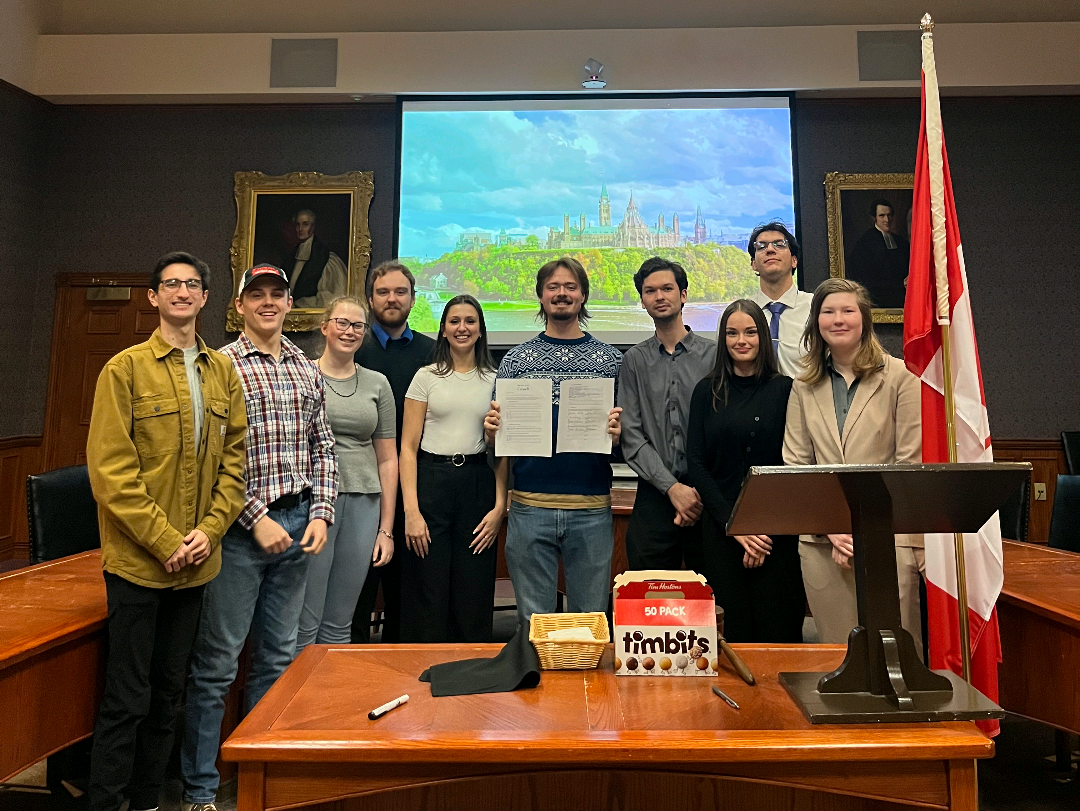
In an exciting experiential learning opportunity, members of the POL216 Canadian Provincial and Territorial Politics class engaged in a simulation of intergovernmental negotiations. The negotiations unfolded over two sessions, the first on Nov. 20 and the second on Nov. 25 in the university boardroom. The simulation environment was especially legitimized by being located in the McGreer boardroom, which gave it an rich atmosphere of political intensity and debate.
Around a dozen students from a number of different major programs participated in this simulation, each acting as a different governmental authority. Some of the provinces and all of the territories were unable to make it to the simulated negotiations, but students took on the role of the premiers of Quebec, Ontario, Alberta, British Columbia, New Brunswick, and Nova Scotia. Exceptionally, Quebec and Ontario had two student representatives each. The Prime Minister, the Minister of Health, and the Minister of Finance were also inhabited by students as federal delegates. The negotiations focused heavily on the construction of a national pharmacare plan, but also included debates around whether Halifax or Edmonton should host the 2030 winter Olympics.
The first day of the simulation was filled with intense negotiations, the effect of which could still be felt in the palpable tension during parts of the second day. The second day of the simulation was packed with events aiding the finalization of the agreement. It began with a press conference where the premiers from each province and the ministers from the federal government each had to answer questions directed to them by some outside mock reporters. After the press conference the floor was opened again to negotiations, followed by comments on the agreement by the various delegations at a formal presentation of the agreement. To end the simulation there was a signing ceremony where the representatives for each province chose whether or not to sign the agreement as finally put forward by the federal ministers. All the provinces but New Brunswick signed.
Ziyad, a Bishop’s politics student who played the premier of New Brunswick, observed that the simulation was very interesting and offered a measure of practical experience that he quite enjoyed. He observed that “everyone is very excited to participate in the simulation and it pushed them to research more about their province”. This appreciative attitude was echoed by the participants in the simulation generally. Antoine Blais, acting as the Prime Minister, explained that this simulation helped to illustrate in a more realistic and fascinating manner the difficulties that politicians face in making national deals. He highlighted that through embodying the Prime Minister, he had learnt that it is actually quite difficult to be a figurehead and that compromise is indispensable in politics. Dr. Robbins-Kanter, the professor teaching the course and supervising the simulation, remarked that the simulation provided a “cool” experience to allow the students to apply the concepts they learnt in class in a fun environment. This simulation illustrated the benefits that experiential learning has in bringing the concepts from the classroom to life.



 The Campus