
By Emily Crunican – Photographer
With growing concerns about climate change and food security, sustainability in the agribusiness sector is more important than ever. Established in 2019, the Sustainable Agriculture and Food Systems (SAFS) program at Bishop’s University prepares students to address agricultural sustainability challenges by equipping them with both theoretical knowledge and hands-on experience.
SAFS students gain a comprehensive understanding of the technical, environmental, economic and social aspects of agriculture. By bridging the gap between agriculture and business, the SAFS program prepares students for the future and teaches skills that extend well beyond the sector of agriculture.
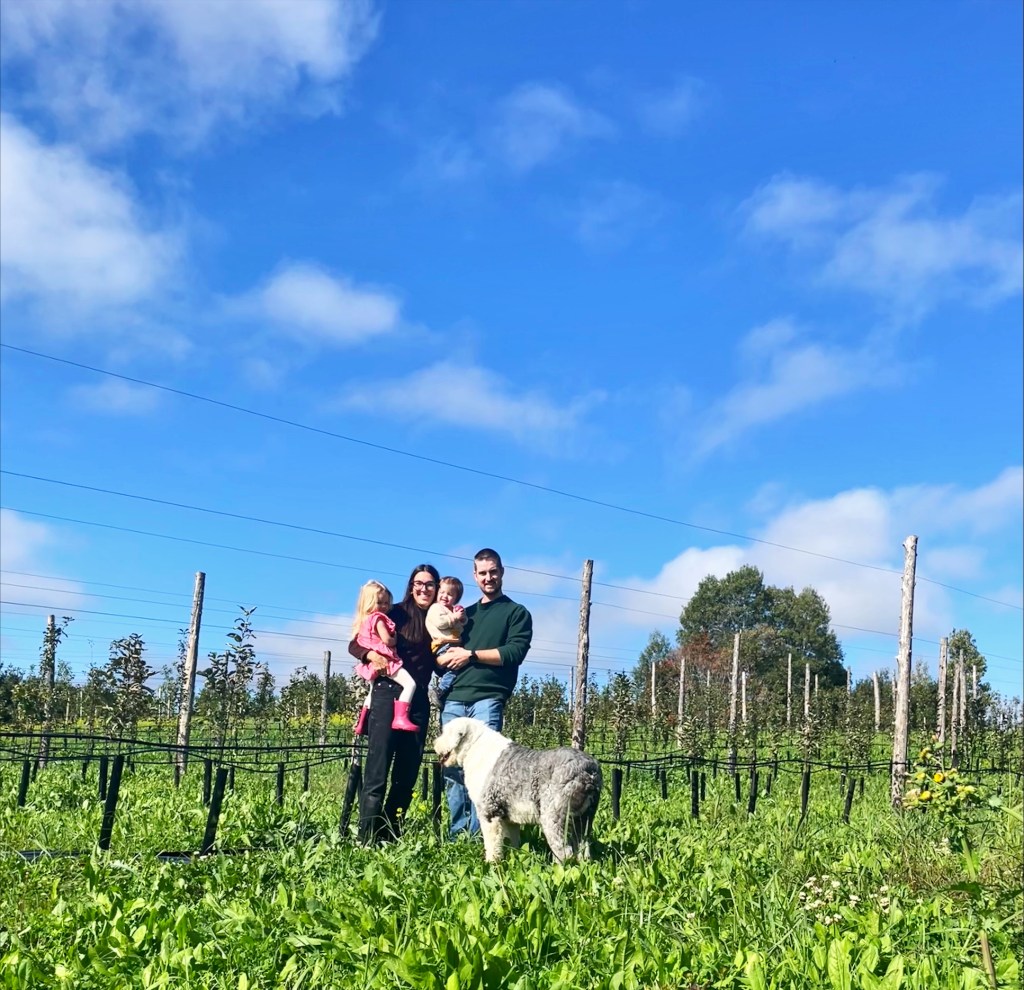
Phillip Haggerty is a Bishop’s student majoring in SAFS and minoring in geography and climate change, all the while establishing his own apple orchard. In the spring of 2024, he and his wife planted around 1000 trees on their land, located just a 10-minute drive from campus. In an interview, when reflecting on the program’s impact, he stated:
“[my] experience in the SAFS program was really eye-opening, mainly because of the food system aspect, that I didn’t have a lot of knowledge in, … it’s been very useful to understand and have a broader picture and more holistic approach to the whole industry. We are working in a very conventionally dominated industry [apple production], and there is a lot of competition in that aspect. The apple industry is conventional because it is hard to grow organically because of what the consumers are looking for and what the industry standards are. So, the SAFS program has brought another vision to that, that it’s possible to have another type of business model that can actually work, based on data, and based on examples we have seen through the course. It’s been motivating to see that there is actually another type of business model that exists outside of the conventional model. Sustainability is not just about environmental practices; it’s a balance between economic, social, and the environment; everything has to be taken all together. A lot of people, I think, don’t think about the social aspect of it. It’s a big part of the SAFS program too, building relationships with the local community and developing a business model that allows for long-term growth. ”
Principles taught in SAFS, such as minimizing adverse environmental impacts and fostering social responsibility, align with growing trends in sustainable business practices. These skills are increasingly relevant, even outside agribusiness for achieving sustainability and corporate social responsibility goals.
Juan Francisco Núñez, assistant professor from both the Environment, Agriculture and Geography (EAG) department and the Williams School of Business, teaches marketing, economics and management courses. In a written statement, Núñez noted that he is aiming to bridge tensions between business viability, environmental stewardship, and social responsibility.
Drawing from his industry experience, he is able to offer cases and transferable skills to bring farm products to markets. He commented that from a SAFS perspective, “in small-scale farming, growing quality food in a sustainable way is just one phase; making the farm operation economically viable requires another set of skills. Sometimes, these skills are different from those used in large businesses and require adaptation”. From a business perspective, Núñez acknowledges that “mainstream businesses are realizing that it is feasible to adopt sustainable and responsible approaches in different areas like procurement and manufacturing, such adoption may be challenging at first, but it contributes to the firm’s performance in the long run.”
Programs like SAFS play an essential role in driving the sustainability movement forward, equipping students to shape a more sustainable future.


 The Campus