
By Rachel Matthews – Contributor
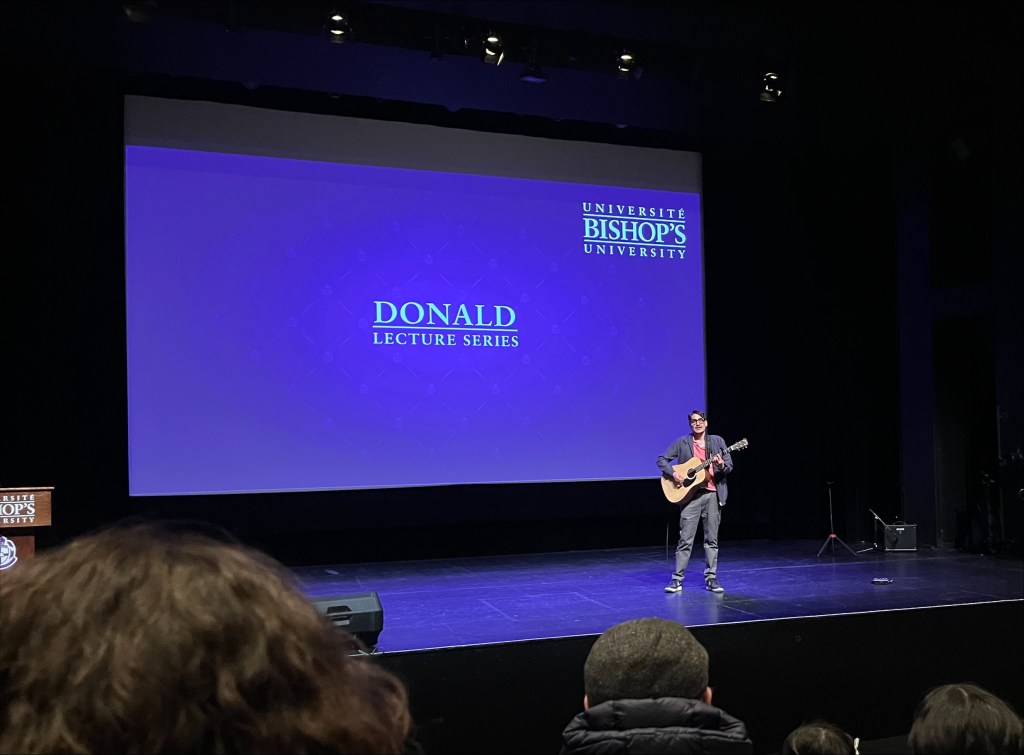
On November 6th, Students, faculty, and community members gathered together in Centennial Theatre for the first Donald Lecture of the 2024-25 academic year. The evening’s speaker was Cliff Cardinal, an Indigenous performer, playwright, songwriter who is renowned for his “black humour and compassionate poeticism.”
Cardinal opened with an anecdote about being asked to come to Bishop’s and speak about Canada’s relations with Indigenous peoples. “No,” he said, “I’ll sing a song.” What followed was an acoustic performance of Cliff Cardinal and the Sky-Lark’s “Christmas in Kingston.”
With this rapport, Cardinal began to share his thoughts on land acknowledgements, using a myriad of analogies, anecdotes, metaphors, and other devices to get his point across. One such example was what he called the “Stolen Land Show,” during which he asked the audience to put themselves in the perspective of someone arriving at the theatre, only to find someone sitting in their seat holding the same ticket. When the usher is called, they merely tell the later arrival off. This, Cardinal explained, is what Indigenous peoples experience every day.
He also made a promise to the audience that by the end of the performance, he would convince everyone to give their land back to Indigenous peoples. Throughout the rest of the show, he periodically returned to this central point. By the end, however, he acknowledged that he knew that that was not going to happen.
He also spoke about how his show, “The Land Acknowledgement, or As You Like It,” a show he performed that night, came to be. He recounted how Crow’s Theatre in Toronto was putting on a production of Shakespeare’s As You Like It, and he was set to perform the land acknowledgement before the play began. The acknowledgement, however, ran eighty-five minutes and comprised the entirety of the show.
Cardinal also provided a brief history of his experience with hearing land acknowledgements. When he first heard one, he told the audience that he thought “somebody [was] finally saying it.” The second, however, was performed by a white man with ties to a multi-billion-dollar company. And then, Cardinal said, he heard about “ten million more.”
He then explored land acknowledgements as a means of “spreading awareness”; which, according to Cardinal, is something we do in “lieu of actually doing something” but still “call ourselves allies.” From there, he examined the problem with people self-identifying as ‘allies’ and ‘anti-racist’. He summarized his sentiment, saying “[d]on’t be an ally, be a friend”.
Along these lines, he also confronted the audience about the tendency to stereotype and tokenize Indigenous peoples in the name of advocacy. “When you evoke Indigeneity as a means to an end,” he said, “you’re not fighting for us, you’re using us as a pawn.” He also spoke on early relations between Indigenous peoples and European colonizers, ruminating on gifts of fur that Indigenous women made for the settlers, and how they were repaid with a genocide of Missing and Murdered Indigenous Women and Girls. Cardinal opened up about how this impacts himself and his family: whenever his sister tells him she is going to the store, for example, he offers to go with her.
Then, he paused. “What are we forgetting to acknowledge?” he asked, repeating the question when the audience remained silent. We are overlooking, he told us, the 2021 discovery of the unmarked graves with the bodies of children at Kamloops. He shared one particular question that he finds himself asking about these unmarked graves and the notable lack of records from the churches involved: was it for “secrecy or convenience?” Did the perpetrators of this genocide leave the deaths unrecorded because they sought to hide their wrongs, or because they perceived their actions as so mundane that recording them was trivial? For all of the talk of living in a so-called “different time,” systems of oppression and violence still currently work to continue the legacy of colonial violence and genocide.
He closed his performance with stories of two women in his life, Shawn Grey and Auntie Neeta, both of whom work to bring food and support to their families. The former went to a store with twenty-five cents in hand to buy one egg for her two children, and Cardinal spoke of the latter as a woman who avenges children of abusive parents. These women, Cardinal said, embody “the spirit that has kept my people alive.” He then told the audience about a phrase in his community, “all my relations,” which means “we’re all related.”
“We’re supposed to be family,” he said, “and we’re not. […] It breaks my heart. I’m Cliff Cardinal and you’ve [witnessed] my land acknowledgement.” With that, Cardinal left the stage.


 The Campus