
Julie-Ann Vollant-Whittemore – Contributor
The National Week of Truth and Reconciliation took place from Sept. 20 to Oct. 4, 2024 at Bishop’s University, in collaboration with Champlain College, Estrie Higher Education, Cégep de Sherbrooke, and Université de Sherbrooke. This two-week period focused on educating and raising awareness around the legacy of Residential Schools and fostering reconciliation between Indigenous and non-Indigenous communities.
At the heart of these events was a commitment to confront Canada’s historical mistreatment of Indigenous peoples, particularly through the Indian Residential School system, which operated for over a century. This system forcibly removed Indigenous children from their families to attend state-funded religious schools to erase Indigenous cultures, languages, and identities, leaving lasting trauma across generations.
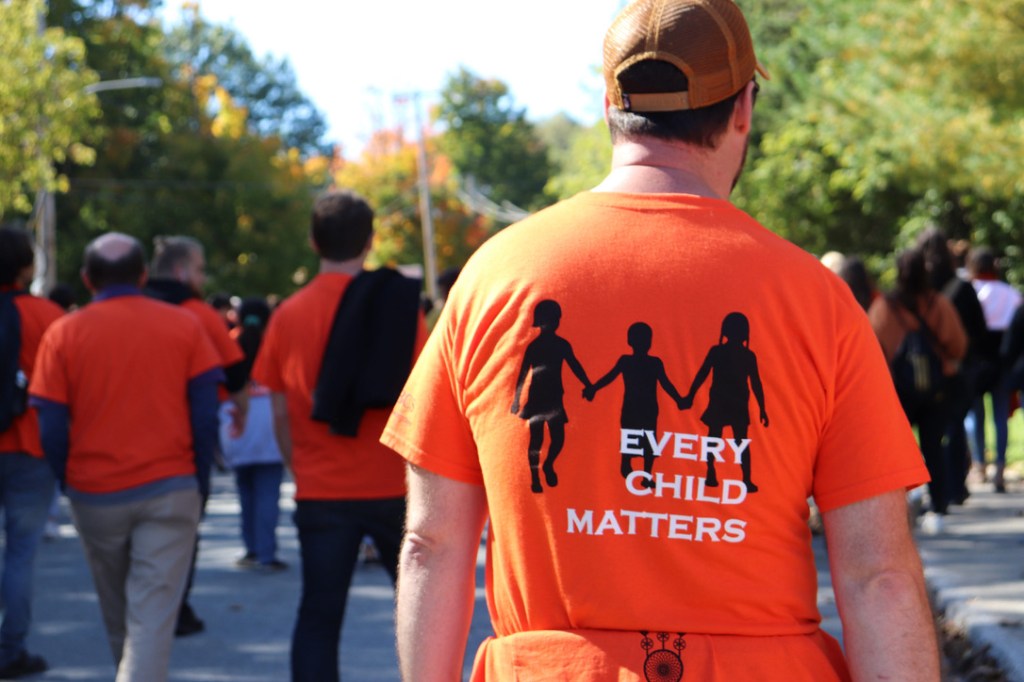
Why Truth and Reconciliation Matters
Truth and Reconciliation Week offers an opportunity for both Indigenous and non-Indigenous people to reflect on this dark chapter in Canada’s history. It’s about acknowledging the past and understanding the ongoing impacts on Indigenous communities today. The week’s events at Bishop’s University emphasized the significance of reconciliation—a process aimed at repairing harm caused by colonial policies and creating a future rooted in mutual respect.
Shawna Jerome, a support worker at the Indigenous Student Support Center (ISSC), stressed the importance of participation:
“This history belongs to all of us. It is crucial to engage in the activities during the National Week of Truth and Reconciliation. It’s our responsibility to learn and unlearn. Moving forward requires building positive relationships with Indigenous peoples and communities. This is not solely for Indigenous peoples; non-Indigenous peoples must also take the initiative in educating themselves and others.”
The History Behind the Orange Shirt
The Orange Shirt has become a national symbol of remembrance through the story of Phyllis (Jack) Webstad. In 1973, Phyllis, a six-year-old Indigenous girl, was sent to a Residential School. Her grandmother gifted her a new orange shirt, which was taken away upon her arrival. The shirt symbolizes how Indigenous children were stripped of their identity, language, and culture.
Orange Shirt Day, observed on Sept. 30 each year, honors Phyllis and the thousands of Indigenous children who suffered under the Residential School system. It’s a day of remembrance and a call to action, reminding Canadians that “Every Child Matters.” Wearing orange on this day shows support for survivors and acknowledges the lasting impact of Residential Schools.
As an Innu woman and third-generation survivor, I wear orange with pride. I am a 2nd-year Bishop’s University student studying pre-clinical psychology and a minor in Indigenous studies. My grandparents survived residential schools, and my father attended Indian day schools. Growing up was rough, full of trauma that still lingers. That’s why I left my community to pursue higher education—to help heal the next generations by bringing knowledge back and being part of a system that once tried to hurt us, but now supports me in building my sense of self.
Wearing orange is a powerful statement for me because we are fighting for change so future generations will be safer and prouder of who they are.
Events at Bishop’s University
The events at Bishop’s University during Truth and Reconciliation Week were diverse and engaging, designed to provide various entry points for learning. From the Indigenous Peoples Atlas of Canada Giant Floor Map to discussions about treaties and land disputes, the programming helped participants deepen their understanding of Indigenous history and contemporary issues.
Vicky Boldo, an ISSC staff member and advocate for Indigenous rights, reflected on the significance of the Truth and Reconciliation process:
“After years of reflection and healing, I feel as though intergenerational survivors of Indian Residential Schools and Day Schools seek justice. Some felt strongly that this was a missing component from the original report. The testimonies confirmed the stories that many had carried for decades. The work is far from done! We are not in post-TRC times.
Apart from pulling out your orange shirt once a year—what will you do to uphold justice for Indigenous rights to land, language, education, self-determination, housing, and clean water?”
Champlain College: A Student’s Perspective
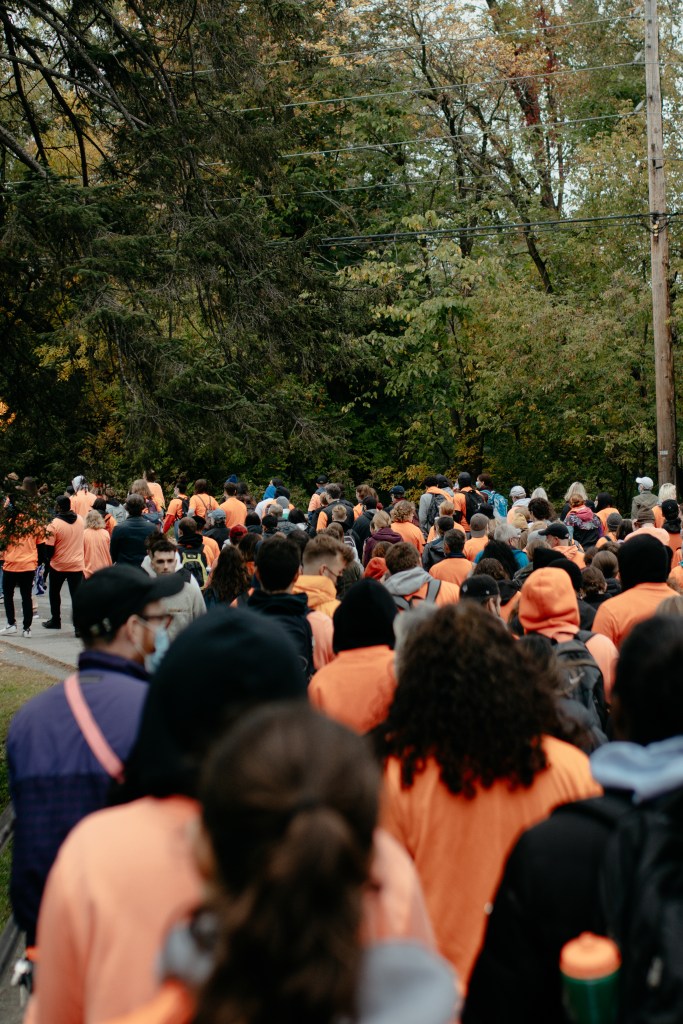
The focus of the week extended to collaborators like Champlain College. During the Every Child Matters Walk at Parc Jacques-Cartier, first-year psychology student Ieriwasetha Dailleboust shared her perspective:
“Kwe, I learned traditional teachings on my land, something I took for granted. Being here made me realize that I carry the knowledge passed down to me.”
Building an Educational Future
Truth and Reconciliation Week at Bishop’s University is not just a time for reflection but also for action. We introduced a new educational tool focusing on Indigenous discrimination, biases, and how non-Indigenous people can become better allies. This project, which took over a year to develop, includes videos, illustrations, and discussion scenarios aimed at building understanding and empathy. I contributed illustrations, including a turtle logo symbolizing Indigenous connections to the land.
Additionally, I spoke on a panel at Champlain College, engaging with current students and sharing my experiences as a former Champlain student and current Bishop’s University student. This moment allowed me to connect with the next generation and encourage them to embrace reconciliation.
The Call to Learn More
Truth and Reconciliation is not just a yearly event, but an ongoing process. The goal is to encourage everyone to learn about Canada’s Indigenous peoples and their histories. Wearing an orange shirt or attending a walk is a start, but true reconciliation requires continuous effort. The events at Bishop’s University are just one chapter in a much larger story, one that we all need to engage with to create lasting change.



 The Campus