
By Elsa Cunnington – Contributor
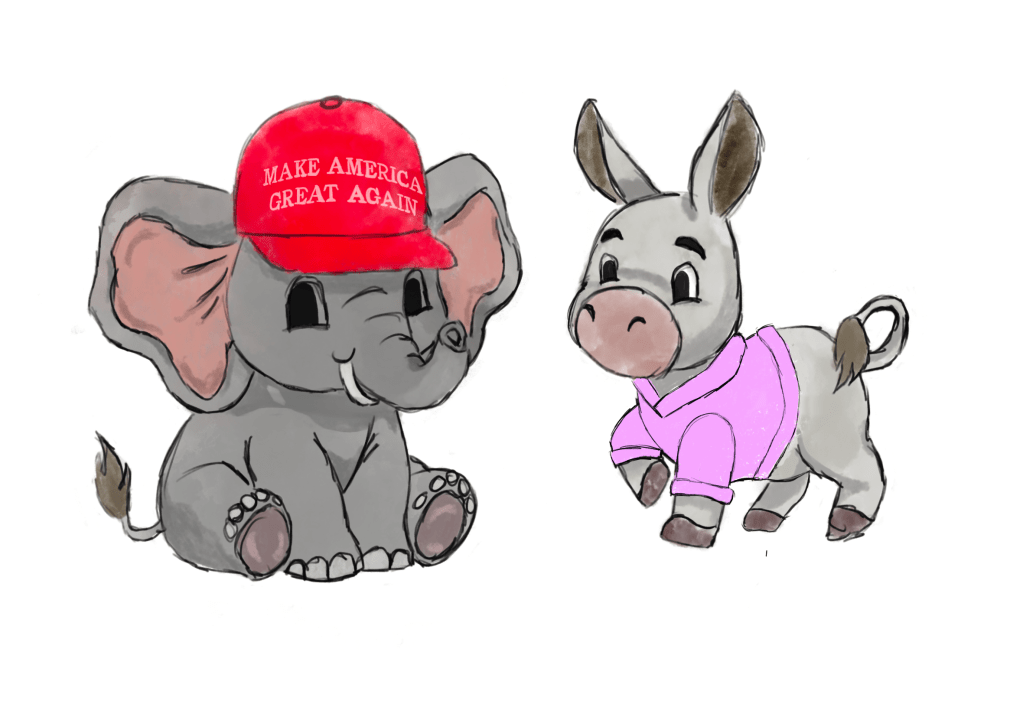
Graphic courtesy of Damita Melchi
Kamala Harris, 49th Vice President of the United States, has been running in the U.S. presidential election for just over nine weeks since she took Biden’s place as the democratic nominee. Her campaign strategy, in comparison to former President Donald Trump, was best exemplified in the recent debate of September 10th. The Harris campaign spent a week on preparations: they ran practice debates with a staffer playing Trump to iron out which points to emphasize and which to avoid. On their part, the Trump team held policy time, where Trump held meetings with aides, who discussed the debate issues.
Going into the debate, there were high expectations from Vice President Harris. She has received media buzz and celebrity attention: Taylor Swift publicly endorsed Harris in an instagram post, and Charlie XCX called Kamala Harris BRAT, a slogan which comes from the singer’s latest album and which Harris’ marketing team has fully adopted. However, polls suggest that many Americans do not feel familiar with her character or policies, and she has often been criticized as being “vague”. She hoped to rectify this in the debate by concentrating on her plan such as “opportunity economy” that presents her as the champion of the middle class. Many agree that she performed well, but voters are still hesitant to embrace the democratic nominee over vague policies on an economic and international scale.
Trump focused primarily on immigration and his plan to fix the economy, but notably made headlines for highlighting an X conspiracy that Haitian immigrants were “eating the dogs” in Springfield, Ohio, which was fact-checked as false by the ABC debate moderators. The resulting memes and viral videos have taken over social media.
In contrast to democratic voters, who are wavering in support for Harris, Trump’s voter base remains strongly influential in his campaign. The “religious right”, a voter base of evangelical christian conservatives, are unwavering in their support of the former president. This dynamic is explored further by Bishop’s professor Dr. Miller in his class on Christian Nationalism in America. When asked about how Trump’s voter base has shifted, Dr. Miller told the Campus that “when he needed [the religious] vote before, he used Mike Pence to cement the deal”. Now, Dr. Miller adds, Trump doesn’t need Pence. Christian nationalists follow him because “he gave the religious right more than they’ve ever had”. Although Harris made a solid impact in the debate, Trump’s voter base is stable, and the election is poised to swing in either direction.
Dr. Miller adds that there is reason to be concerned over Trump’s tendency to bend election narratives: “In 2016 Trump will claim he won by a landslide. When he lost to Biden by the same number of votes, he lost by ‘a hair’. This election, Dr. Miller adds, extends beyond policy. “Christian nationalism is anti-democratic”, he explains. “They don’t believe in voting anymore. Unless they win, it was rigged. [Trump] would love to win the popular vote, but [he] has a Plan B: use election deniers, and throw every lawsuit they can at it”. This post-election commotion is what drove nationalists to the Capitol building on January 6th after Trump’s 2020 election loss.
As the presidential candidates prepare to enter the last stretch of their campaigns, they vie for control over several swing states, including Arizona, Georgia, and Michigan. With such an action packed election, the coming weeks are certain to be interesting as we draw nearer November and the campaigns employ their final election strategies.



 The Campus