
Katlyn Stoneburner – Features Editor
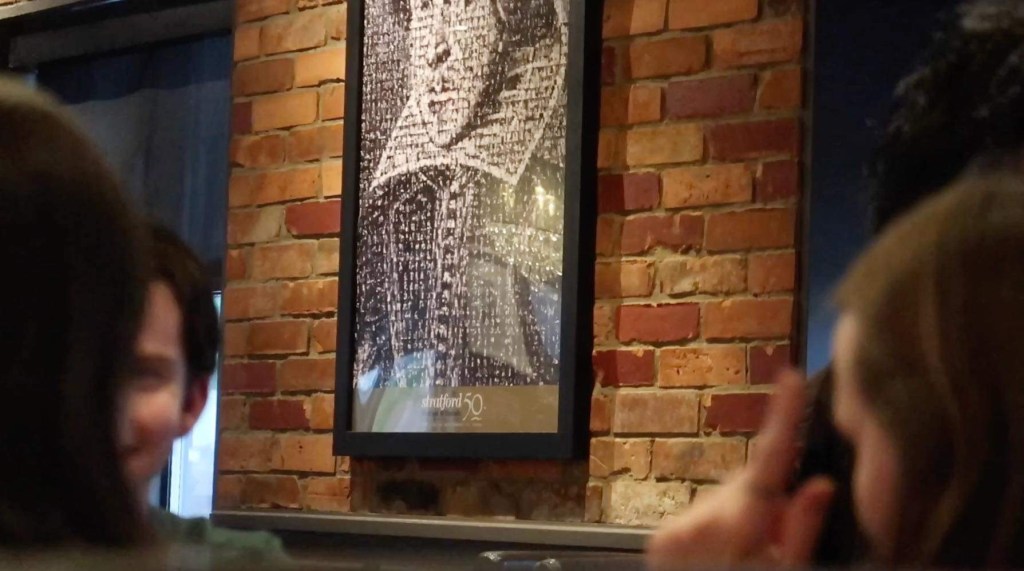
Photo courtesy of Riley Marie Handy
This summer, students from Bishop’s University, Carleton University, Mount Allison University and the University of Northern British Columbia embarked on a unique journey to the Stratford Festival for Shakesperience, an immersive and experiential course run by Drs. Jessica Riddell (Bishop’s), Lisa Dickson (UNBC) and Shannon Murray (UPEI). The course is not just about Shakespeare, but about building community, fostering hope and engaging in deep, collective learning.
Building beyond the classroom
The course spanned three weeks of online modules, including micro-lectures, podcasts and other asynchronous assignments, culminating in a week-long trip to Stratford, ON. This year’s theme, “A World Elsewhere,” was particularly fitting, as it highlighted how “theatre builds worlds that are removed from our own everyday experiences so we can see and think differently,” said Dr. Riddell. The theme encouraged students to move beyond passive observation and actively engage with live performance through new perspectives.
Participants reflected on the impact of the course’s focus on self-directed learning. Many found the opportunity to consider the difference between being a student and a learner transformative, highlighting the value of developing agency in their own lives. This reflection highlights one of the central ideas of the experience: that learning involves more than absorbing information—it is about actively shaping your own experience.
The Stratford experience
Once in Stratford, students were immersed in a rich array of live performances, behind-the-scenes tours and interactive workshops. As Dr. Riddell noted, the festival invited audiences into “worlds elsewhere,” helping participants “expand imaginations and build hope circuits”—a key objective of Shakesperience. The course’s intergenerational nature also played a significant role in fostering diverse dialogues. Through meaningful conversations, participants realized that despite their differences, they had much in common. Recalling conversations had with fellow participants, Hoya Kabayiza noted that these exchanges “made the trip even more special and showed how no matter what age we are, we have a lot more in common than we think.”
Kabayiza considered the impact of these shared experiences, contemplating how the group, despite their differences in age, bonded over their love for theatre and the arts. “I feel like there were so many moments throughout this experience that stood out to me,” Kabayiza shared. From seeing the shows to learning fun choreography from Something Rotten, Kabayiza emphasized that one of the most memorable moments was the first night when the group came together and shared their favorite things about theatre. “It made it such a full circle with the last night, with how much we connected in a short period of time,” Kabayiza added, highlighting how the experience of forming such connections underscored the importance of the theatre community.
The diversity of life experiences within the group also brought forth new perspectives. Participants noted how the wide variety of viewpoints led to diverse questions and insights, opening up new ways of thinking that otherwise might have gone unexplored. Some described stepping outside their comfort zones as an essential part of their personal growth during the experience, helping to cultivate growth and transformation through the experience. Dr. Riddell emphasized that both theatre and universities act as “hope circuits,” teaching us to slow down, reflect, practice divergent thinking and embrace the complexities of the world. Students were not just spectators of Shakespeare’s work—they learned to question traditional authority and engage deeply with their communities. Students were asked to contemplate the importance of ongoing personal growth despite uncertainty, emphasizing the belief that while the future is unpredictable, individuals have the power to shape it through their efforts.
A broader impact
Shakesperience is deeply tied to concepts of justice, equity and empathy. According to Dr. Riddell, “Higher education and the Stratford Festival share a common purpose of citizen building and collective action that centers justice, equity and empathy.” For participants, the experience of being part of such a diverse group allowed them to reconsider how they viewed others and what unites people across differences. The course’s intergenerational aspect broadened horizons, teaching participants how to play an active role in an ever-evolving Canadian society.
At its core, Shakesperience is about more than just Shakespeare—it is about engaging with theatre and education as essential public institutions. “Canada has the best publicly funded, social mission institutions in the world,” said Dr. Riddell. “Alongside higher education, the Stratford Festival is essential to the creation and maintenance of a civil and just society.” Participants came away from the experience with a renewed sense of the importance of community building, with many reflecting on how the experience inspired them to take an active role in improving the world around them. The program fostered an environment where participants could reflect, connect, and build bridges, emphasizing the significance of shared experience in creating lasting bonds.
With a shared mission of world-building in collective and communal spaces, Shakesperience exemplifies how theatre can unite diverse thinkers and challenge students to imagine a better world.

Photo courtesy of Riley Marie Handy

 The Campus