
Megan Légaré speaks about finding her space in research
By Gabrielle Liu – Editor-in-Chief
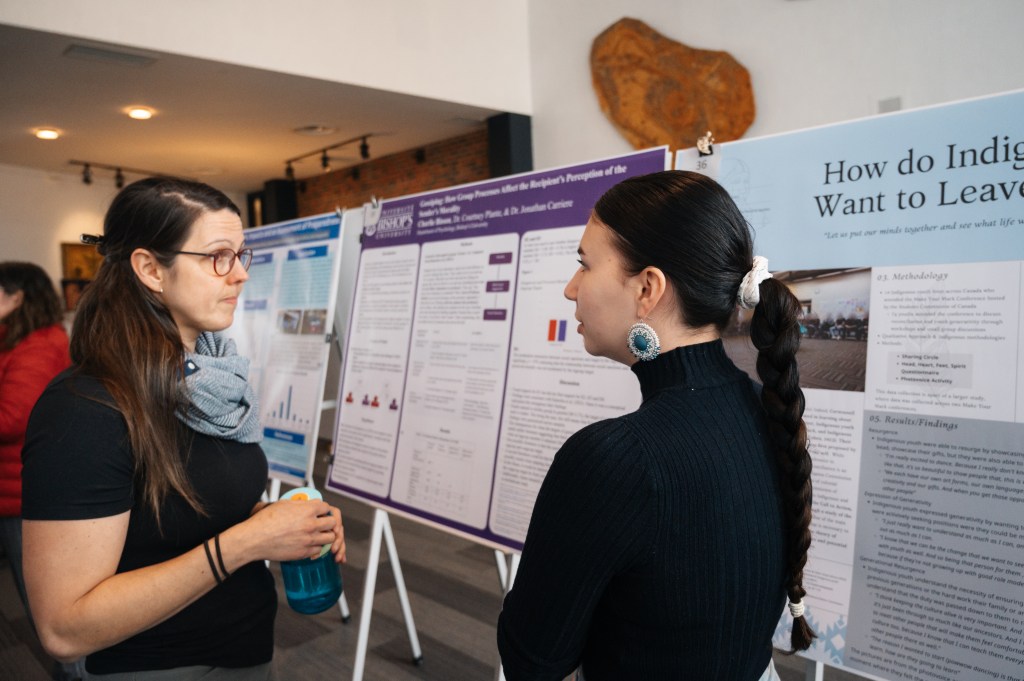
Megan Légaré recently presented her master’s project on Indigenous youth generativity, the way youth leave behind a legacy by working with the next generation. “What is the legacy they want to leave behind? What pushes them to share it and connect with it?” she asked.

To unpack these questions, Légaré’s research involved consulting 10 participants from the Make Your Mark Conference by the Students Commission of Canada (SCC). She built relationships with these participants throughout several workshops and activities beyond the conference.
Her research involved Indigenous methodologies, such as sharing circles. Sharing circles are similar to traditional focus groups, Légaré noted. However, she would pass around a talking stick – an eagle feather – and open circles with a smudge to root the participants in cultural practices. Unlike a focus group, the researcher is equal with the participants in a sharing circle and is obliged to be connected, rather than distanced from them. “We are going to be in this together,” she recalled telling her participants.
She incorporated photovoice, a method where people take photos to capture their perspective on an issue. The process of participants explaining why they took the photo evoked oral storytelling. Photovoice allowed her to include youths’ vision beyond written word.
She also used a method developed by the Students Commission of Canada called the head, heart, feet and spirit tool. This exercise asks people to reflect on what they learned, felt, wanted to do and how they connected during an experience. Légaré said this method understood individuals’ perspectives more holistically.
She explained that she spent an entire year trying to find research methods that would respect culture and allow her participants to speak freely and feel interconnected. Her participants felt safe, she noted, even though they were vulnerable and discussed emotional topics.
Légaré pointed out that Western science often poses itself as unbiased. However, “according to Indigenous ways of knowing, we all have biases,” said Légaré. She highlighted cultures’ emphasis on acknowledging the relationships between things, and not simply relationships to things. “We acknowledge the bias and don’t hide behind objectivity,” she said. Even a scientific poster using traditional research methods will have bias, Légaré points out, as there is a reason why the researcher is exploring and feels connected to a subject.
Légaré’s research interests began during her undergraduate honours psychology degree. She was introduced to the concept of generativity under Prof. Heather Lawford’s work. After reading many transcripts and finding that she could identify when it was Indigenous youth speaking, she began an honours thesis with Prof. Lawford on Indigenous youth generativity, a space with little research. Prof. Lawford and Légaré later brought on Prof. Vicky Chartrand, who led her on a path to incorporate Indigenous research methods. Vicky Boldo, the associate director of Indigenous initiatives, also mentored Légaré in her research, raising awareness that she’d have to develop relationships and build trust with her participants; otherwise, she could be viewed as an outsider.
“I felt like I didn’t belong in Indigenous spaces because I didn’t grow up on res [sic.],” said Légaré, when describing her research journey and upbringing. When she finished her bachelor’s, she didn’t want to pursue a path in clinical psychology. She also didn’t see herself in research because academia is not very welcoming to Indigenous people, Légaré expressed. Due to various discouraging factors, she said she had given up on graduate school. However, Prof. Lawford opened up a master’s degree, and Légaré embarked on her new thesis.
Now, she says she looks forward to publishing her thesis. Légaré underscores a sense of responsibility towards her participants and how they would like to see the knowledge mobilized.
“This work is important,” she said. “This work is not about me. It’s about [the youth] and the work they’re doing.” Research doesn’t tend to show the “good side” of Indigenous youth, but, “We are more than a status card and alcohol”, says Légaré. Their knowledge, perspectives and experiences are worth something, she closed.


 The Campus