
By Jillian French – Contributor
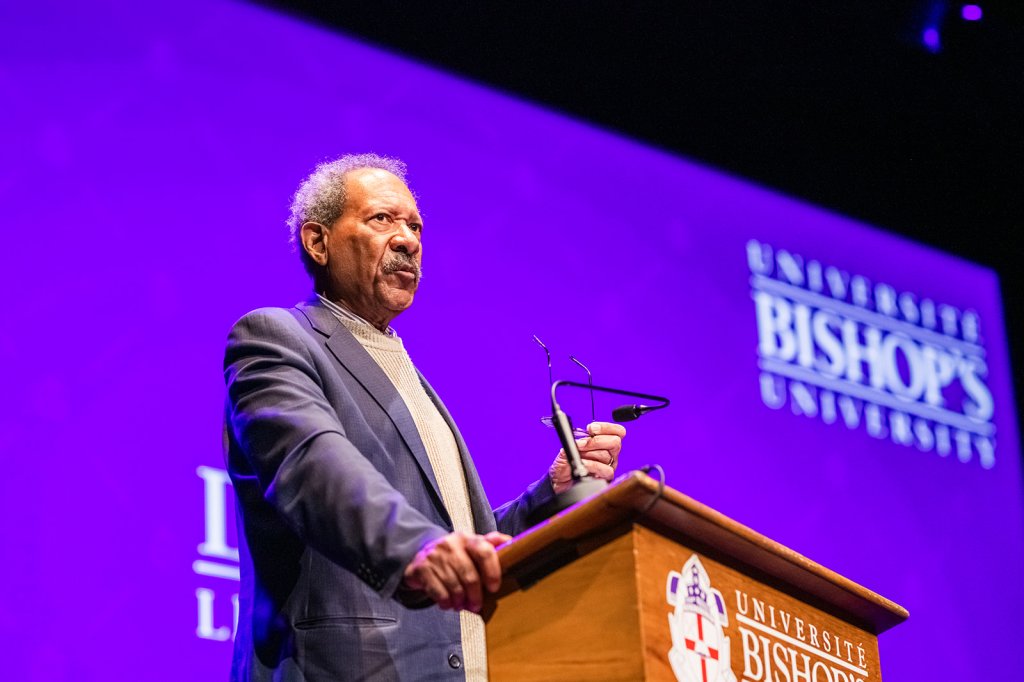
As Black History Month drew to a close, students, staff and community gathered in Centennial Theatre on Feb. 20 to hear Prof. Robert J. Cottrol’s Donald Lecture on the American gun debate from a racial violence perspective. Prof. Cottrol hails from the United States, where he works as a research professor of law and professor of history and sociology at the George Washington University. His expertise in law and history carved a walk through gun ownership in the colonies to present-day tensions between racial minorities and authorities. Throughout this journey, he traced both racial violence and armed resistance as a response.
The lecture began with an introduction to the right to bear arms, the Second Amendment. Prof. Cottrol explained that in the colonies, “the notion that the population should constitute a militia [rose] in part due to race control”. This gave white settlers an advantage following a “persistent cycle of three-way violence” between the white settlers, Indigenous communities and Black slaves. Importantly, in some states like Maryland, slaves were given the right to bear arms, with their owner’s permission. This catalyzed arms as a mechanism of self-defence among racial minorities, becoming “a mark of freedom and citizenship” among Black slaves, Cottrol explained.
Post-Civil War, the 14th Amendment established citizenship for Black Americans. However, in the south, “Many [retained] the view that Black people may be free, but not citizens”.
Prof. Cottrol noted that as the Klu Klux Klan rose to prominence, the government abandoned protecting Black citizens, leading to the “restoration of white rule by private violence”. In the 1873 case United States v. Cruikshank, for example, 100 Black men were massacred for arming themselves at the polls, but the Supreme Court ruled in favour of the defendant. He explained how this decision undermined Black Americans’ right to arms, further exposing them to racial violence.
The end of World War II saw increased armed resistance to racial violence. Arms deterred several lynchings by confronting racist mobs, and the National Association for the Advancement of Colored People (NAACP) “started registering Black voters when the federal government offered no protection, and local police were more likely to be part of a racist white group than to offer protection from it”.
When the Klan asserted its opposition, the NAACP registered itself as a National Rifle Association (NRA) gun club. Upon realizing their opponents were armed, the KKK withdrew. Prof. Cottrol expressed the significance of the “reinvigoration of Black voting power”, noting how “armament may very well have made the civil rights movement possible”.
Despite the role of guns in African American history, Prof. Cottrol described how more recently, violence has shifted primarily “from racist groups to micro-cultures of hyper-violent groups in urban Black communities” as “a result of marginalization and exclusion”. This has resulted in “present-day estrangement between Black people and the police”, he described. Although it’s tempting to view the gun debate as exclusively American, he pointed out the wide reach of the issue, citing Toronto’s disproportionate rates of police homicides with Black victims: “These long-standing patterns of conflict with police and [a] lack of protection fuel desire for guns”.
Although the historical use of arms may recommend them as a tool to diffuse violence, the desire for handgun support inevitably reflects “a fear of stricter gun control on Black people”, exacerbating disproportionate incarceration rates, Cottrol said. “It’s hard to put forward solutions to this problem, but we must realize that solutions start with a realization of the complexity and long-standing nature of the problem”, he concluded.
In response to audience questions about the effect of the Black Panther movement and, more recently, the Black Lives Matter movement that returned with the 2020 murder of George Floyd, Prof. Cottrol explained that these movements are targeted at raising a profile for Black resistance to racial violence. However, “the people who made a real difference were those you never heard of… the most successful cases were those men who didn’t crow about the fact that they had beaten the Klan”, he said.
Although Prof. Cottrol acknowledged the many complexities of the gun debate, his lecture settled on the necessity of arms for civil rights defence. “Today”, he noted, “people are still using guns to protect rights, to defend lives and communities”. Recalling a conversation with a skeptic in France, he asked the audience to consider, “Should the state have a monopoly on force?” [America] is the one who asks that question. We may ask it imperfectly, but we ask it”.

 The Campus