
By Melodie Anderson – Contributor
This winter, through the program BioLocaux, 22 organic farms and food producers have joined forces to offer diversified vegetable baskets to the Eastern Townships, with Bishop’s as a drop-off location. The vegetables, along with bread, eggs and fruits upon request, are distributed biweekly in the SUB.
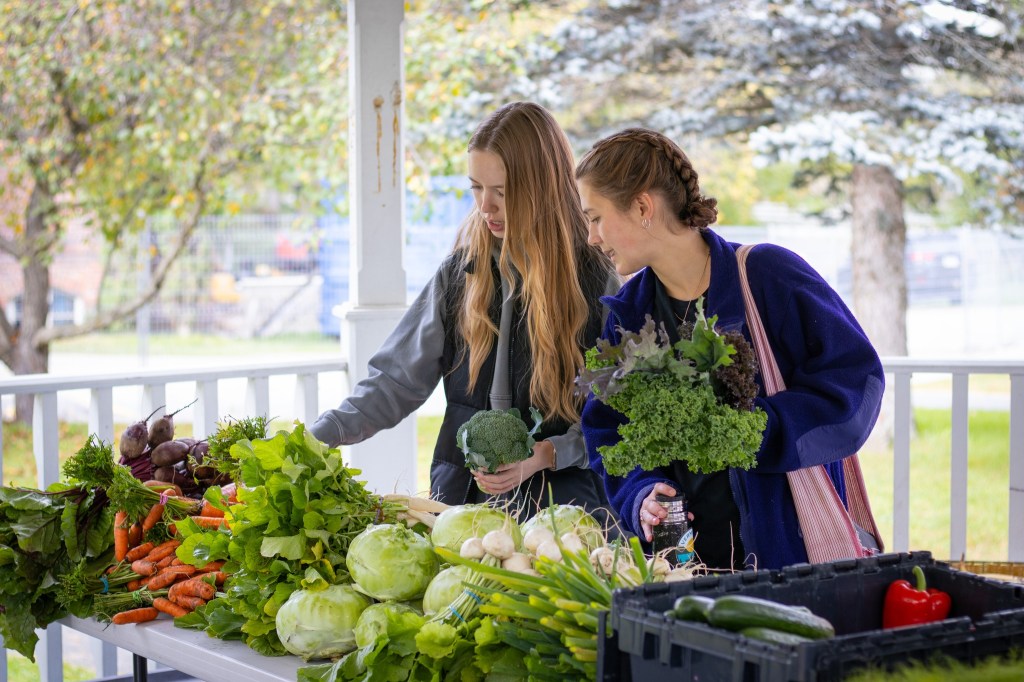
Since the fall of 2022, the Sustainable Development Office (SDO) has facilitated a community-supported agriculture (CSA) project by linking the Bishop’s community with local farmers so they can access local produce all year long. CSA projects are a partnership between a farmer and community members who subscribe to a weekly or bi-weekly produce basket, agreeing in advance to buy the farmers’ products for a fixed period. This guarantees an income for the farmer and allows them to plan their production while also being directly connected to their customers. The farm then becomes more of the community’s farm, with the farmers and eaters providing mutual support and sharing the risks and benefits of food production.
The socio-ecological transition in agriculture often encourages better farming practices to care for and even regenerate agro-ecosystems. The transition is also about a renewed concept of agriculture that restores it as an essential economic activity at the basis of our communities.
Eating seasonally
Above all, subscribing to a CSA basket is an agreement to eat what is locally available at the moment. Consequently, it tends to force people to move away from their usual food habits and to learn to cook less familiar produce.
Kim McFadden, career and development advisor at Bishop’s, has been benefitting from the CSA project in both the fall and winter. “I loved the surprise of seeing what products were offered each week, and it was fun to cook creatively with various root veggies, greens and dehydrated beans and lentils,” she said when asked about a highlight of her participation.
Local farms have more than one trick up their sleeves to offer a variety of vegetables in all seasons: storage, processing, greenhouse and tunnel growing, etc. The collaborative approach facilitated by BioLocaux this winter enables an extraordinary diversity of produce for eaters. Èvemarie Durant, a sustainable agriculture and food systems (SAFS) student, was “pleasantly surprised by the freshness, quality, and variety [that CSA baskets] offer – both in summer and winter”. Sara Watson, a neurosciences student with a SAFS minor praised the wide selection of produce which “allows me to get both my essentials such as onions, potatoes and carrots and discover fun products such as the watermelon radishes and sunchokes! It never feels redundant, and I look forward to it every two weeks!”
Farmer-eater relationship and the local economy
While the CSA model may not be replacing the current food system, it has contributed to a growing interest and increased demand for local food. Eating local indeed means fewer “food miles” along the food chain, which reduces transportation emissions. CSA is also about supporting our local economies. When asked about the reasons why she subscribed to the CSA baskets, Watson explained that she loved being able to put her money “directly toward local and sustainable agriculture and the overall local food system.” The money spent on local foods, especially through a CSA system, remains and circulates within the local community.
Toward a new food culture
When it comes to CSA, buying local is also about a new food culture where food is no longer a commodity, but rather an essential product from a community member. CSA makes it possible for farmers and eaters to meet and exchange. Eaters can receive first-hand information on how their food is grown and deepen their understanding or appreciation of where their food comes from. The interactions may also help break down farmers’ isolation and recognize them as the heart of our communities. Camille Lussier is the owner of the farm Les Hôtes Épinettes in Cookshire-Eaton, providing the Bishop’s community with summer and fall vegetable baskets since 2022. She says CSA is “more than a farmer-customer transaction”. Instead, “it’s a very special meeting place that has allowed me to form beautiful friendships.”
“In the end, CSA is about relearning to cook and eat what we should in our climate and give importance back to farmers”, says Frédérique LeBlanc Piette, SAFS student and intern for the SDO. “We have to learn a new food culture.”
Community members hoping to join Bishop’s CSA project may still sign up for the remainder of the winter vegetable baskets distributed biweekly on Thursdays. Visit BioLocaux’s website at https://www.fermierdefamille.com/en/biolocauxcantons/ to subscribe. Registration for summer baskets offered by Les Hôtes Épinettes is now open at http://www.leshotesepinettes.ca/bishops.html
Melodie Anderson is a graduate intern for the Sustainable Development Office.
Correction: A previous version of this article said Melodie Anderson was a student intern. She is a graduate intern with the Sustainable Development Office. The article also described the term “green housing” as a way farmers grow vegetables throughout all seasons. This has been corrected to “greenhouse growing”.



 The Campus