
By François Leblanc — Contributor & The Campus staff
In the first Donald Lecture of 2024, aerospace engineer Farah Alibay walked attendees through her upbringing as the daughter of immigrants and her dynamic professional career at the NASA Jet Propulsion Laboratory.
Alibay was born in Montreal as the daughter of immigrants from Madagascar. Her early years were spent in the town of Joliette, Quebec where they were one of few visibly racialized families. During her time in middle school, Alibay was particularly inspired by the career of the Canadian astronaut Julie Payette. Payette hailed from Quebec, and she was a significant role model for Alibay.

Alibay’s family moved to England. There, an influential high school teacher pushed her to apply to Cambridge. She recalled the teacher telling her, “Farah, don’t take yourself out of the competition before it even starts.”
Alibay ended up being accepted into and attending Cambridge. She recalled that during her bachelor’s degree, women made up only 20 per cent of engineering at the time, with even fewer women of color in that field. “I didn’t see anyone that looked like me”, she said, and many students were from wealthier backgrounds. This socioeconomic difference and perception that she didn’t belong was compounded by failing exam marks in the middle of her first year. Alibay transformed her performance by asking for help from professors and peers, eventually finishing ninth out of 300 engineers at the university. She also completed her master’s in aerospace and aerothermal engineering at Cambridge.
Alibay then pursued a PhD at the Massachusetts Institute of Technology (MIT). While at MIT, she completed three internships at NASA. From her skills, networking and persistence, Alibay secured a position in NASA’s Jet Propulsion Laboratory. In 2019, she joined the Mars 2020 mission as part of the mobility team which made sure the Perseverance rover didn’t get lost on Mars. Alibay also worked on the Ingenuity helicopter which performed the first powered, controlled flight on another planet. These were particularly impressive accomplishments, as the final stages of the Mars 2020 mission happened during the beginning of the COVID-19 pandemic. “Planets don’t wait,” said Alibay.
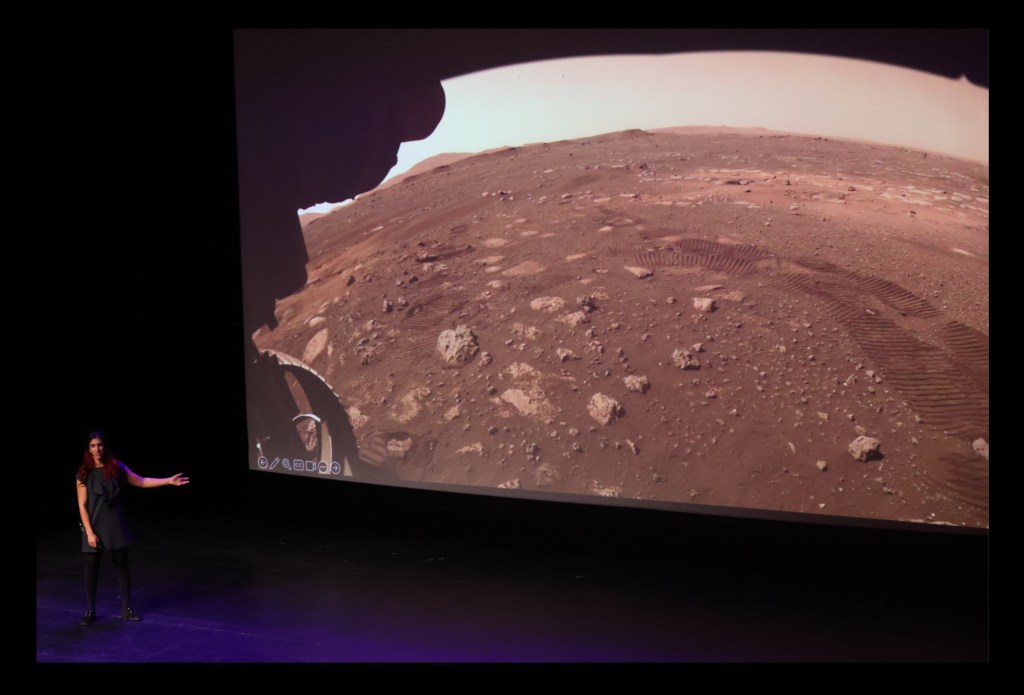
Alibay noted that her favourite part of her job was working with a team of passionate colleagues. Yet, in 2014, “We weren’t really talking about women in STEM, or diversity or what that meant. . . . I was the only brown woman [on our team]. I’m always the one who has to bring the snacks or go make the coffee. People would talk over me during meetings,” she said. She recalled her ideas being dismissed only to be praised when someone else proposed them and even someone else being asked to present Alibay’s research without due credit. “I thought, maybe I’m not cut out for this,” she said. “Maybe, they treat me that way because I am not good enough.” After speaking to her supervisor, he was able to help make changes in the team environment.
At the end of her lecture, Alibay answered questions about the future applications of artificial intelligence, how rovers are named and how materials were specifically tailored for Mars’ environment. She told The Campus about what advice she would give to herself as a young university student.
“Don’t stress so much,” she said. During her studies, “I felt the pressure of looking at people around me, where they were at their careers and where they were at their studies.” She recalled that in her first year in graduate school, she didn’t publish, but in another year, she published three articles.
“There is no straight path. Don’t compare yourself to the person next to you because your journey is your own, and you’ll get there”, she said. She wouldn’t have believed that her career would be like this 10 years ago, she said. “I wish I had taken a breath, maybe enjoyed my university experience a bit more — taken the time to enjoy my surroundings and the people I was around with,” she expressed.


 The Campus