
Content warning: descriptions of violence, mentions of genocide
By Savana Cianci – Contributor
The International Court of Justice (ICJ) commenced a two-day public hearing starting last Thursday, Jan. 19, regarding South Africa’s allegations that Israel violated its obligations under the Genocide Convention. Israel defended itself at the United Nations (UN) court as South Africa requested the ICJ to order Israel to cease its military campaign in Gaza, accusing their actions of being “genocidal in character”.
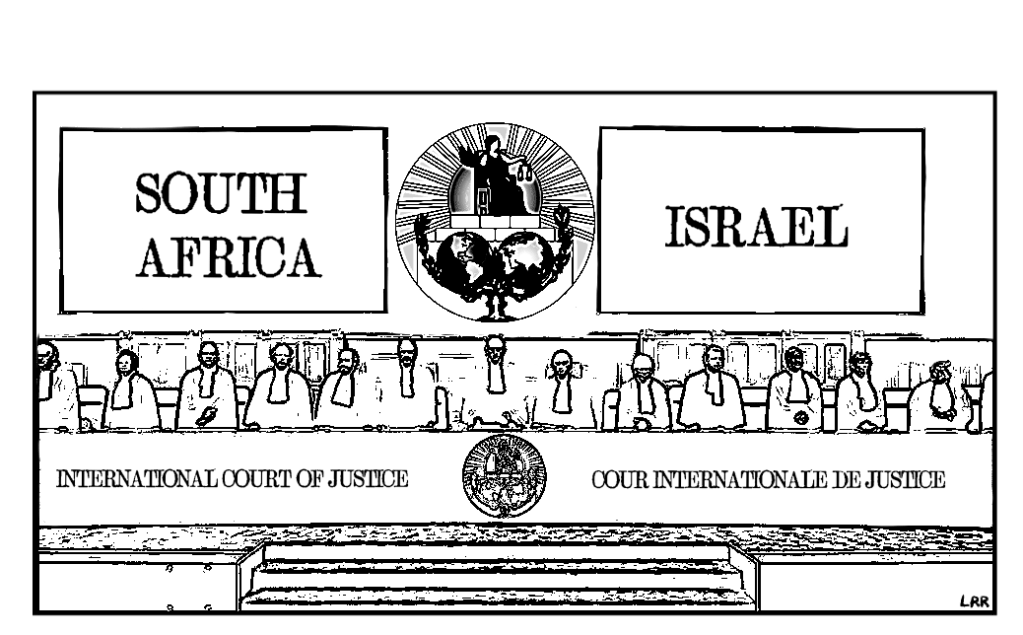
More than 100 days since Hamas’ Oct. 7 attack, marking the most recent surge in violence, the death toll in Gaza is over 25,000 according to Palestinian authorities. The UN Relief and Works Agency stated that 85 per cent of Gaza’s 2.2 million population – 1.9 million civilians – have been displaced since the beginning of the war.
On Dec. 29, the South African government submitted an 84-page application to the UN court alleging that Israel has failed to fulfill its commitments under the Genocide Convention. This international treaty obligates signatories to prevent and punish the crime of genocide. South African lawyers highlighted the last 76 years of systematic oppression and violence that Israel has inflicted on Palestinians while claiming Israel’s extrajudicial killings, bombings and restriction of resources “intended to bring about the destruction of a substantial part of the Palestinian national, racial, and ethnical group”. They also highlighted comments made by Israeli leaders and soldiers as “genocidal speech”.
Israel has categorically denied these accusations, claiming South Africa’s case was “unfounded”, “absurd” and amounting to blood libel. Moreover, Israeli lawyers argued this case was a deliberate attempt to distort the meaning of the term “genocide”. They say that they do not target civilians and that the casualties are not genocidal in nature, but an unfortunate consequence of military action in an urban area. Israel’s defense also argued its right to self-defence following Hamas’ Oct. 7 attacks and maintained there was a lack of evidence of genocidal intent. Germany and France have both come to Israel’s defence, rejecting all genocide accusations.
Prof. Trygve Ugland, a full professor in the politics and international studies department at Bishop’s University, noted in an email that “while relatively few countries have so far officially supported South Africa’s genocide case against Israel, there seems to be a broader agreement that Israel has not fully respected international law following the [Oct. 7] terrorist attacks in that Israel’s military operation in Gaza does not seem to be proportionate, and that the operation has caused excessive harm to civilians and civilian infrastructure”.
While Canada’s Liberal government has expressed its support of the ICJ and the process of international law, that “does not mean [Canada accepts] the premise of the case brought by South Africa,” read a statement from Minister of Foreign Affairs Mélanie Joly. The statement said that there is a high threshold of compelling evidence needed to make the case. Prime Minister Justin Trudeau, in turn, said Canada is “watching carefully” as the ICJ deliberates on this case. However, he would not indicate whether Canada is in agreement with South Africa’s accusations.
Midge Cadeau, an honours international studies student at Bishop’s University, was of the opinion that “this trial could provide an opportunity for South African activists, lawyers and NGOs to mobilize global support”, pursue greater human rights accountability and exert pressure on states, international organizations and courts.
Demonstrations have erupted worldwide, involving hundreds of thousands of individuals. In the last few months, pro-Palestinian demonstrations have taken place in London, Vienna, Medan, Kuala Lumpur, New York and other major cities across the world. In turn, pro-Israel protesters have flooded capitals’ streets, including London, Paris and Berlin calling for the release of hostages still held by Hamas in Gaza.
The final ruling on the genocide case will take years. What South Africa asked for in the hearings last week is for the ICJ to issue “provisional measures” – temporary orders for a state to cease actions as to prevent irreparable harm. For these to be awarded, South Africa would have had to prove the violated rights under the Genocide Convention are at least plausible. No matter the ruling, ICJ decisions are difficult to enforce. While South Africa’s allegations against Israel have elevated this issue to the forefront of global political discussions, it does not indicate an immediate end to the war in Gaza.




 The Campus