
Content warning: Descriptions of the Israel-Palestine conflict, anti-semitism, Islamophobia
By Micah Della Foresta – News Editor & Gabrielle Liu – Editor-in-Chief
Last Monday, Nov. 27, the Board of Student Representatives (BSR) postponed their decision to adopt a proposed statement addressing the impact of the Israel-Palestine conflict on students’ wellbeing. The meeting, open to all students, ran 15 minutes overtime after discussing the statement, an amendment and whether to move into a confidential discussion. A supplementary Dec. 4 BSR meeting finalised and passed a statement that will be released on social media platforms.
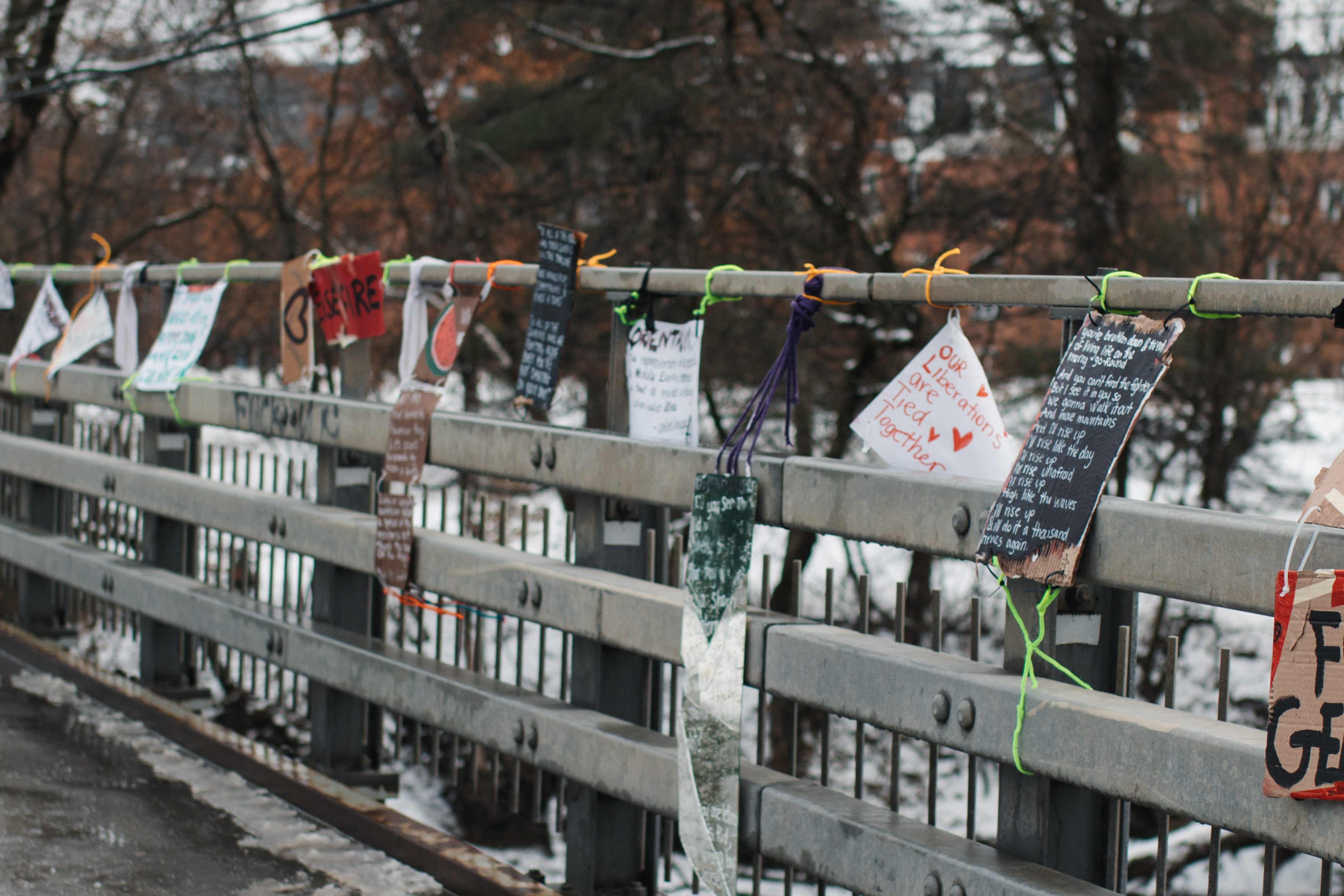
The delay comes after the Nov. 13 BSR meeting where a different statement failed to pass, citing needing further time to consult with student groups. Since then, on Nov. 22, an expansive string of posters and messages has stretched across the bridge approaching the Bishop’s campus. Complaints, calls for action and support for Palestine laid across the railing over the Massawippi River. The Muslim Student Association has held a keffiyeh fundraiser and organized poster-making sessions for protests since. Other students, as Monday discussions show, question the role and scope of the SRC to make a statement. Their bylaws state the “SRC may adopt a position on any issue that directly affects the wellbeing of the membership.”
Equity representative Irma Susset submitted the proposed statement on the floor last Monday, Nov. 27. It stated: “In light of recent global events, we are deeply troubled and saddened by the tragic and ongoing loss of civilian lives in Palestine. Your BUSRC is concerned about students’ well-being and psychological health and is committed to providing support to students.” It followed with encouragement to consult, generally, mental health resources on campus and “accredited educational resources on the topic”. Susset clarified during the meeting educational sources would be Amnesty International, the United Nations and Human Rights Watch.
Six observers stood together that day to reveal a message on their shirts and hold a Palestinian flag in front of the Board for the duration of the discussion. One of the students, Yousef Al-Haddad, says he has a stepmother in Gaza right now who is unable to get out. He told The Campus over a video call that while a statement wouldn’t change the situation in Gaza, it would at least make him feel supported to see someone standing with him. “I was crying like a baby”, he said when he first heard the news. “I can’t focus on basic tasks, so I can’t focus on my courses.” When the meeting closed, he told BSR members he had to drop out of all his classes this semester.

An observer at the Nov. 27 BSR meeting, Virginia Rufina Marquez-Pacheco, delivered a statement calling on the SRC to acknowledge that students’ emotional and mental well-being are being impacted by the ongoing events in Gaza. “The silence of our representatives while we experience this is all the more hurtful,” she read. Addressing fears of being accused of being anti-semitic, she told the BSR that the Jewish people are not the government of Israel, as evidenced by the vocal opposition of Jewish communities to the violence in Palestine. “In fact, we are also calling on you to vigorously condemn the rise in antisemitism and the rise in Islamophobia occurring because of this escalation of violence,” she said.
When questioned at the meeting why the proposed statement only mentioned Palestine, Susset said it was the result of her consultations with students. She said the statement could be amended to include that the SRC condemns all forms of anti-semitism and Islamophobia.
Since Hamas’s Oct. 7 attack and the Israeli government’s subsequent bombing and strikes in Gaza, there has been a rise in both antisemitism and Islamophobia on Canadian soil. Montreal has been the site of growing cases of reported hate crimes, as in early November there were bullets fired on three separate occasions into two Jewish schools. Most recently, on Nov. 27, a Molotov cocktail was thrown into the front entrance of a Jewish community center in Côte-Des-Neiges–Notre-Dame-De-Grâce. Canadian Prime Minister Justin Trudeau has condemned the attacks, saying that the violence must stop immediately.
A Canadian Senate report that was released in November highlighted an existing and increasing prejudice towards Muslims in Canada, which has continued to develop since the conflict began. The report found that one in four Canadians do not trust Muslims and that Canada leads the G7 countries in terms of targeted killings of Muslims motivated by Islamophobia. “The profound effects of gendered Islamophobia are such that it compels certain women to consider removing their hijabs to enhance their employment opportunities,” the report said.
During the BSR discussion, multiple members of the Board affirmed the SRC’s commitment to peace and safety, and some expressed a desire for the statement to remain neutral to include all students, either by including Israel with Palestine, or sticking to a general recognition of “global events”. A proposed amendment with the removal of Palestine and educational materials from the statement – citing inclusion and risk of affiliation – saw tied votes, failing. Susset called the amendment as “removing all the humanity” from the statement.
Marquez-Pacheco said in an interview that “There is a difference between acknowledging pain on both sides versus not weighing in at all” by leaving out mention of the specific conflict in Israel and Palestine, saying there is power in naming a situation. She said that at the very least, changing “global events” to “ongoing human rights violations” in the statement would be better.
“BSR members are trying their best to represent all students”, says SRC President Sophia Stacey when asked about several BSR members’ repeated mentions of neutrality. She says Board members have indicated they’ve felt verbally intimidated during this time as well. Stacey had been the first to introduce a statement at the Nov. 13 meeting which she described as more neutral, without direct commentary or mention of the events in Israel or Gaza. No other BSR member responded to a request for comment.
Neither the Christian Students Association nor the campus chaplain was aware of students from the Israeli or global Jewish community willing to make a statement.
Jewish students “feel under siege” right now, says Prof. Daniel Miller, regarding this. The professor from the religion, society and culture department spoke to The Campus in an interview. Jewish people have a visceral reaction when they hear activists say they hate Israel, he explained, because the state was created in response to the killing of Jewish people. He maintains “genocide” and “colonization” are incorrect terms that are causing a spike in antisemitism, saying they are used as a “cudgel”, holding Jewish people collectively responsible for the Israeli government and associating Hamas’s mass murders with decolonization. He notes that criticism of the term “genocide” does not exonerate the Israeli government from the killings. When students use these terms, he says he understands it comes from good intentions, but there is still a need for accurate and constructive discourse. The discourse he hears is not targeted at the government or Hamas enough. He points out that many left-wing Jewish people like him decry the Israeli Prime Minister Nentanyahu’s government’s dehumanization of Palestinian people (many of whom he underscores Hamas killed on Oct. 7) and now feel left out to dry, abandoned by liberals, betrayed by Nentanyahu.
Both the voices of Israelis and Palestinians must be included, he says generally about university statements; Otherwise, there should be no statements at all. If not with both voices, a statement acknowledging people’s pain would be good, he said; “The reasons I am in pain are different from the reasons others may be in pain, but there is a shared pain.”
“Feeling that I don’t have the power to change [the conflict] wrecks me,” says Muhi Tahhan, a student from Syria who says he follows the news closely, disturbed that Palestinians are treated as collateral damage. “It’s hard to sleep at night thinking about it.” He says a statement would at least make him know the community supports him. “When did it become so hard to be human?” he asks.
Mohammed Abdullah Ab Al Fohiti, the Vice President of the Muslim Student Association (MSA) wrote in a statement that the MSA has “been unwavering in its commitment from the very outset to advocate for Palestinian rights and promote a call for ceasefire and lasting peace. The current situation in Palestine is undeniably devastating, and as a community, we must unite and raise our voices against the ongoing humanitarian crisis.”
On Nov. 24 a four-day truce between Israel and Hamas was brokered by Qatar, extended to seven days. On Nov. 29, speakers at the United Nations called for a permanent sustainment of the truce. But on Dec. 1, a deal was not reached, and the fighting resumed.
The BSR struck a supplementary meeting for Dec. 4 where an amendment changed the statement to recognise both the violence in Palestine and Israel, as well as other international conflicts. It expressed the SRC’s acknowledgement of the pain and grief of those whose loved ones are lost or missing. Stacey expressed that it was time to pass a statement, one that acknowledged all students’ pain as that was their job as representatives. She noted that not all students were comfortable or felt safe expressing their opinions, further encouraging an encompassing statement. Board members noted that voting by secret ballot was necessary for their mental, physical and psychological wellbeing given unkind comments they have received. Susset opposed the inclusion of Israel in the statement, saying that it would be better not to release a statement at all, than recognise the oppressor, the state of Israel, which she also distinguished from the global Jewish community.
The BSR approved the amended Dec. 4 statement, and it is expected to be released on social media platforms.
This article and headline was edited on Monday, Dec. 4 12:42 p.m. to include updates from the Dec. 4 BSR Meeting.
This article was corrected on Monday, Dec. 4 3:34 p.m. to correct a statement from Prof. Daniel Miller in the seventh to last paragraph to read “does not exonerate the Israeli government from the killings”.
 The Campus