
By Diane Drak Alsibai – Contributor
Research is an important aspect of the environment, agriculture and geography (EAG) department. Students and professors are fueled by curiosity and seek solutions to ongoing environmental issues. The EAG department created the Undergraduate Bishop’s Earth Research Group (UBERG) to allow students to gain research skills through experiential learning and pursue their passion for studying the environment while benefiting the surrounding community. UBERG is an active program of the Multi-scale Climate and Environmental Change Research Group at Bishop’s University.
UBERG’s projects are mainly based on the study of aquatic activity in nearby lakes through geospatial data and remote sensing. These projects are run by Prof. Bruno Courtemanche and Prof. Elisabeth Levac for EAG and biology students. They receive funding from the department, and there are also honours projects subsidised by the government. A few projects even involve collaboration with Université de Sherbrooke. UBERG is also an opportunity for the university to promote its excellence in educational research.
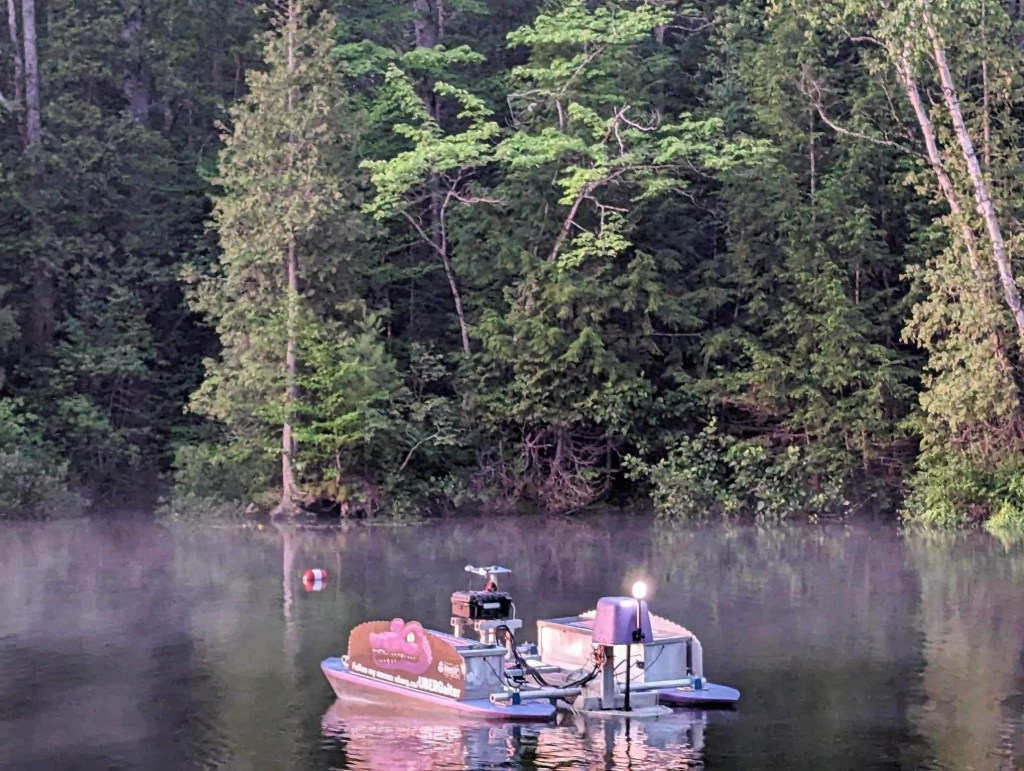
Currently, there are two ongoing projects within UBERG. The first one, titled Lacustrine herbarium identification by air and marine drone (Ubergaiter), involves using drones to monitor underwater herbaceous species, aiming to accomplish more efficient aquatic plant mapping.
UBERG is also carrying out three-dimensional mapping of Quebec caves to improve techniques in gathering cavern telemetry, a type of remote data collection.
Each of these projects has a group of students working on it as well as aid students working on their honours and masters theses. The team is made up of 13 undergraduate students and two graduate students.
Jacob Guité, a fourth-year environmental studies student, has been involved with UBERG for two years. He’s worked on a previous UBERG project aiming to monitor pollen grains in lakes, which has since stopped running after research challenges. As of now, he works with a group of other students on a diving project involving the removal of an invasive aquatic plant, the Eurasian milfoil, during the fall season.
Steven Poulin, who is completing his masters in computer science, prepares his thesis on the Ubergaiter, shown in the image with this article. The Ubergaiter is an autonomous water drone that will automatically map and categorise various underwater plants around different lakes, taking underwater photographs. The drone usually runs at night so pictures have consistent lighting. Lake O’Malley, a small lake near Mount Orford, was the first lake to have its plants photographed and mapped out.
“[B]oth the vehicle and the dataset are novel offerings developed here at Bishop’s, which will help boost our understanding and decision power towards improving the management of invasive aquatic plants,” Poulin wrote in message. “I am grateful to local lake associations and contributors, and it also led me to do quite a bit of scientific communication,” he shared.
UBERG continues to go forward with research projects throughout the year and welcomes more students. Students do not necessarily have to be enrolled in the environment and geography program to be involved.
For more information about this opportunity or how to get involved, students can reach out to info@uberg.ca or bcourtem@ubishops.ca. Additional information can also be found at https://uberg.ca/.



 The Campus