
By Micah Della Foresta –News Editor
Since the Quebec government announced plans to drastically increase tuition fees for out-of-province students, Bishop’s leaders, faculty, students, alumni and surrounding community members alike have rallied to make a stand against a policy they believe would lead to severe losses for Quebec and Bishop’s future.





Protests
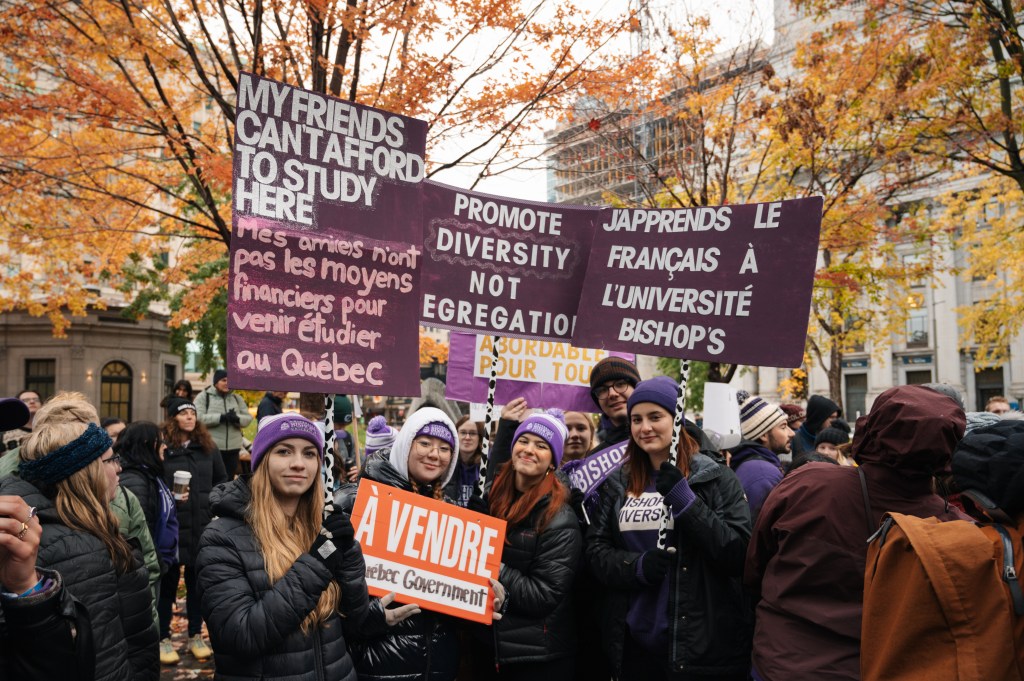
Bishop’s joined Montreal universities in a protest against tuition hikes on Monday, Oct. 30. The Bishop’s University Student Representative Council (SRC) arranged four buses to downtown Montreal, where a crowd of at least 1000 marched from Dorchester Square to Roddick Gates, across from Premier Legault’s Montreal office. Bishop’s students and members of the community bore signs in English and French criticizing the tuition hike’s impacts on out-of-province students.
Martina Berkers, a fourth-year student and education senator for the Board of Student Representatives said at the protest: “I think it’s really important for Bishop’s to show up here today to get our voices heard, to make sure we are seen, so that we can continue living on after 180 years.” Berkers grew up attending French institutions. “I just don’t see how someone like me, someone coming from a French institution, a French high school, could be a threat to Quebec’s language.” Berkers said their goal was to become a French teacher in Ontario, and they came to Bishop’s because “It would be an added plus for me to be immersed in French culture, the French environment.”
Erika Leduc, a first-year Bishop’s student at the protest said that “even though I’m from Québec, I believe that everyone should have a right to a fair tuition. . . . Right now, the generation of those in university – as much as the people who are born in Quebec or outside of Quebec – are the future of our workforce and economy. You might not want to push them away.”
The Campus reached out to Professor Jacob Robbins-Kanter, assistant professor in the politics and international studies program, who was meant to speak at the protest but did not get the time before Bishop’s departure. Robbins-Kanter sent in words he had prepared: “It’s extremely important that we mobilize in opposition to this policy, for example, by emailing our Members of the National Assembly. But in mobilizing, it’s equally important to recognize the legitimate aims of the government and not to engage in hyperbole or Québec-bashing,” the speech said. Robbins-Kanter’s speech emphasized Quebec’s leadership in accessible education in Canada and the world, its values for social solidarity and the legacy of the Quiet Revolution – stating that “deep unprecedented inequality in the higher education system” could undermine Quebec’s positive example. This inequality “could theoretically spread elsewhere, including to in-province students”, he wrote.
Echoing the need to understand the legitimate aims of the government to promote French, Antoine Cliche, a fourth-year Bishop’s student from Magog, highlights revenue disparity between English and French universities. Opponents of the tuition hike cite the average undergraduate tuition in Quebec and Canada as comparable, rejecting the claim that out-of-province students benefit unfairly from cheaper tuition. However, Cliche cautions against using tuition averages to understand program costs, because the costs per program differ. Certain programs like medicine are more affordable here, he says, and they are more affordable because of Quebec taxpayers. He emphasized about the out-of-province students: “I don’t think it is malevolent that they are coming for cheaper education,” he said, but “at some point, we are still bearing the cost”. He does believe that the Bishop’s is in a different situation than McGill or Concordia, genuinely worried about their survival.
Petition
A joint petition of the BUSRC and McGill and Concordia student associations has garnered over 18,000 signatures as of Nov. 13. Sponsored by Marwah Rizqy, the Quebec Liberal Party’s higher education critic, the petition calls for the government to rescind the tuition policy for all out-of-province and international students. In particular, it cites Bishop’s unique role in the Eastern Townships. The signing deadline is Nov. 27.
Regional Response
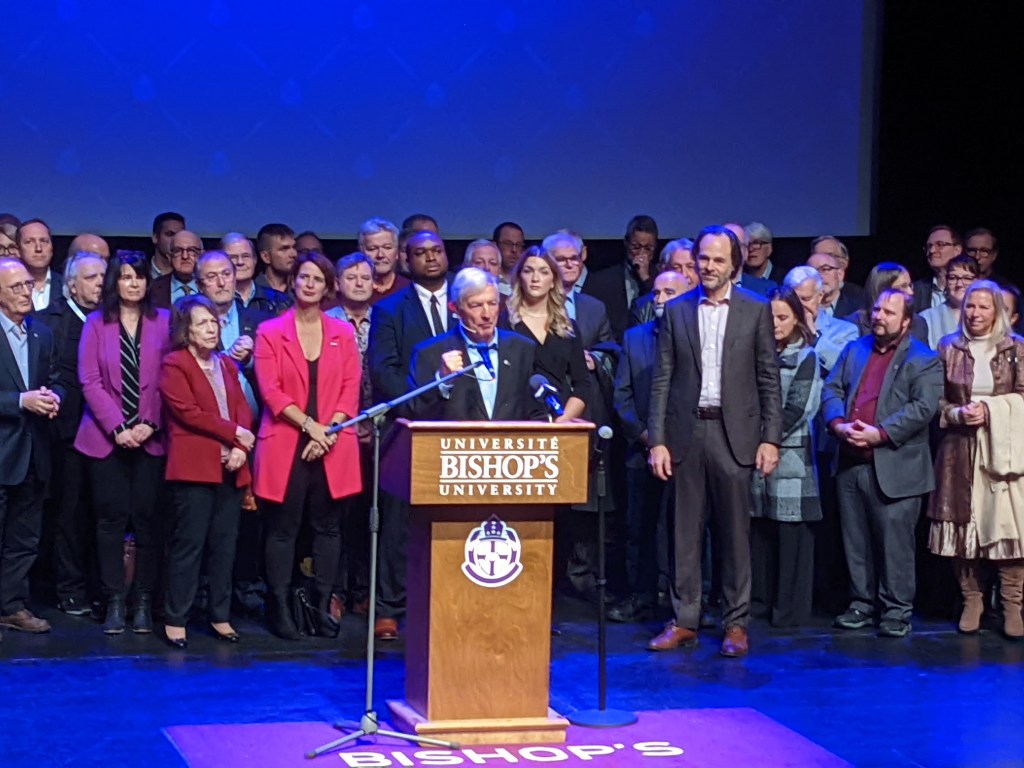
Regional leaders coordinated on Oct. 31 at Centennial Theatre in a demonstration of their solidarity with Bishop’s University.
According to a press release from the Bishop’s University, community members part of the steering committee included former Sherbrooke Mayor Jean Perrault; Louise Bourgault, vice president and director general of the Sherbrooke Chamber of Commerce; Claude Bellau, Bishop’s Alumnus and former general director of Estrie Aide; Chantal Lessard, associate with Raymond Chabot Grant Thornton; and Yanick Crack, associate with Groupe TCJ. Joining them were over 100 leaders from various sectors: business, media, municipal affairs, culture and academics, in the Eastern Townships.
During their press conference in Centennial, acting mayor Raïs Kibonge spoke of Bishop’s influence in the region, and the Principal of the Université de Sherbrooke Pierre Cossette described the many partnerships between the two universities. Many students at Bishop’s often end up studying at UdeS, he noted.
An open letter by the community leaders addressed to Premier Legault and Minister of Higher Education Pascale Déry stated: “The presence in the Eastern Townships of Bishop’s University and the approximately 800 students from other Canadian provinces who have chosen to study here does not jeopardize the vitality of the French language in our region.”
SRC president Sophia Stacey, who spoke at the event remarked: “We fully accept the importance of protecting the French language. Bishop’s is not eroding the presence of French in Montreal, nor in Lennoxville, Sherbrooke, our home community. Despite this, Bishop’s will bear the most severe consequences of the government’s proposed policy.”
She, like many other students, found their academic home in Quebec based on motivations to be immersed in French culture, understanding the value of developing French proficiency and contributing to its prosperity.
English universities’ proposition
On Nov. 11, Bishop’s Principal and vice-chancellor Sebastien Lebel-Grenier, along with the heads of Concordia and McGill met with Quebec Premier François Legault and Minister of Higher Education Pascale Déry. The universities proposed a plan to heavily incentivize French courses and activities in the universities, a combination of mandatory French courses (in McGill and Concordia) and initiatives to boost students’ mastery of the language. They set an ambitious goal to have “at least 40% of non-French-speaking students enrolled in undergraduate programs reach level 6 of the Échelle québécoise, equivalent to level B2 of the Common European Framework of Reference for Languages, by the time they graduate,” read the proposal.
Shortly after, the government indicated they would stay course with the tuition hike policy. Statements to media outlets said they’d continue looking for a specific solution for Bishop’s University. Premier François Legault recently said in an interview with the Montreal Gazette that: “The main challenges are about McGill and Concordia. I don’t see much of a threat in Sherbrooke about French, so we may try to find other solutions for Bishop’s.”
The proposal cited the devastating financial consequences for the universities and criticized the redistribution strategy: “Instead of adequately funding Québec universities, the government is setting up a system whereby funding for French-language universities becomes somehow dependent on the ability of English-language universities to recruit Canadian and international students. As the government has announced its intention to reduce this recruitment, it is taking away the English-language universities’ ability to do so.”
Among proposed initiatives include more pathways to proficiency and professional integration in French working environments, as well as scholarships offered to students who certify level 6 of the Échelle québécoise.
They concluded their proposition by stating: “We firmly believe that universities have a fundamental responsibility to contribute to the dynamism and vitality of the communities in which they operate. English-language universities are particularly recognized for their contribution to Québec’s social fabric, as well as to its reputation nationally and internationally.”
The universities now await further developments from the government and what a specific solution for Bishop’s looks like.


 The Campus