
By Emily Crunican – Photographer
Within the past year, there has been increasing concerns in education regarding the use of artificial intelligence (AI) tools such as ChatGPT and OpenAI. On Oct. 17, Kylie Readman, the vice-chancellor and vice-president of education and students at the University of Technology Sydney visited Bishop’s University and presented the integration of AI tools in education. The presentation was titled Assessment and Academic Integrity in the Context of GenAI.
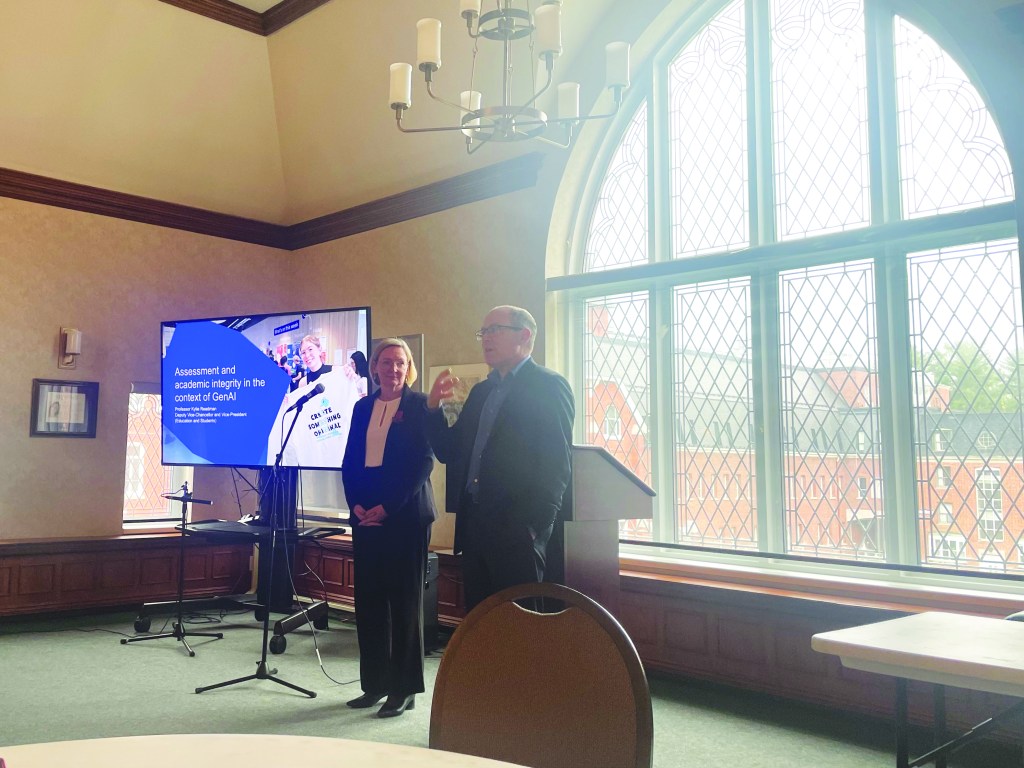
Andrew Webster, the vice-principal of academics and research at Bishop’s University, states that Australia is six to eight months ahead of Canada in terms of addressing AI in education. Readman explains that there are good uses of AI in education that enhance learning in an appropriate way. This can include using it to understand statistics or summarize a text to clarify the main takeaway.
Readman addresses that the line between AI being a learning tool versus one for academic misconduct is very vague. Students want to know how they can appropriately use this tool, to enhance learning and to be equipped to use it in the workplace after graduation.
She goes on to further address the opportunities and risks posed by AI in education. Over the last two or three years, there has been a higher range of diversity in assessment types. AI tools can be used to enhance learning in these assessments.
There are also opportunities for faculty to use AI to design these assessments. Though there are ways to appropriately use these tools, students can stray into academic misconduct by taking shortcuts, which Readman states undermine education as you can not outsource learning. Furthermore, how can faculty members rest assured that the student who is submitting the work is the one doing the work and understanding the content?
She emphasizes that given the fact that Bishop’s is a small, tight-knit school, that this is part of the solution to this question. Smaller class sizes allow for a more personal experience, and faculty are more likely to recognize the work of one of their students. Readman emphasizes that one of the biggest deterrents for cheating is the thought that their instructor who knows them well will find out. She believes this is something that Bishop’s University should capitalize on.
It is crucial to understand that education is not only about acquiring knowledge but also about fostering moral and responsible individuals. As Readman puts it, “Assessment and learning experiences equip students to participate ethically and actively in a society pervaded with AI.” Readman also states that universities have a responsibility to take action, and support faculty throughout the process of navigating the use of AI tools in the classroom.
Near the end of the presentation, Webster asked Readman, “Where do you think we will be, 12 months from now?”
She replied that there is a lot of work to do to understand the influence that assessment type has on the use of AI in education. Readman concluded by saying that this is an “ongoing conversation for the whole university sector,. . . and it is a conversation we are never going to stop having. This is now a part of the learning landscape.”



 The Campus