
By Journey Bardati – Contributor
I had written exactly one half of a script prior to writing for the New Plays festival, an idea that emerged from taking the Playwriting II class at Bishop’s. The script was god-awful despite my internal monologue telling me it was in fact the greatest masterpiece known to man that must be talked about to everyone, everywhere and in every conversation I found myself in. “This,” I told myself, back when I was delusional, “will be my magnum opus.” It had a ridiculous fake-Latin title, an overly complicated fantastical plot, and only the protagonist had an actual name.
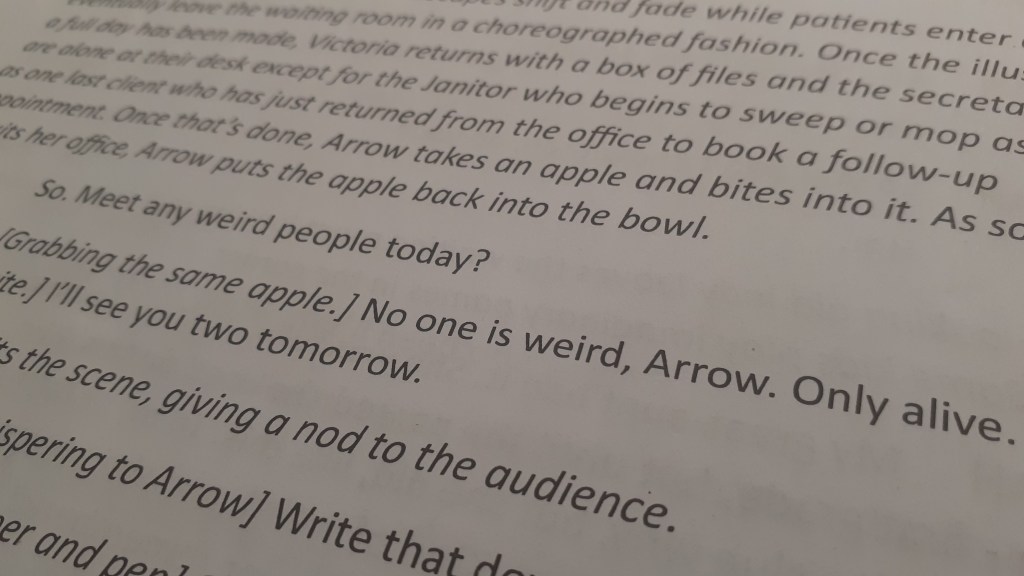
Now, don’t get me wrong: just because it was a stupid play doesn’t mean it was useless to write. I had to write it in order to learn what not to do, to get the initial “I-have-no-clue-what-a-plot-is” out of my system, so to speak.
But, it was two simple, timeless, oft-shared pieces of advice from George Rideout in the course DRA282 that helped me tremendously when writing my first full one-act play for New Plays: “The truth is in the details” and “write what you know.” In other words, a scene will come across as more genuine if you’ve in some way experienced it, because you’ll be able to pinpoint the little things that make the situations so memorable.
I think the class as a whole latched onto this advice, as they’ve all written brilliantly personal plays that leave the audience with questions. Many of the plays have been chosen for the festival. Death and the Afterlife playfully examines various perspectives on the matter, The Gossips tells a story of small-town rumours inspired by a Normon Rockwell print and Bridges and Coffee deals with grief and sapphic love. All are wonderful inventions and so are the others I haven’t mentioned. As for mine, The Waiting Room is exactly what the title implies – the audience is invited into the lives of people united by their shared location. It’s a little silly, a little heart-wrenching and a little bit lovely. Nothing abstract, just people being people.
So, with all that newfound knowledge from Playwriting II, does that mean that I am now an excellent writer, and my play is extraordinarily well-written? YEAH, IT DOE— No. No. I wish! But no. Do I feel bad for the guy directing my play? Absolutely. I still struggle with Over-Complication Syndrome, as is evident in the fact that there are fifteen characters total played by six actors. There are still many aspects I would’ve changed if I had the time.
But grace must be given to amateurs, because as a friend of mine likes to say, art takes courage. The act of writing a finished, tangible synthesis of ideas – that is, the externalization of something as nebulous as the internal chaos of an individual’s mind – is in and of itself a great feat, regardless of how it is received. That process of solidifying abstract ideas into finite words should be commended, I feel. So, I would highly encourage everyone to watch both Night A and Night B of the New Plays festival (running from Sept. 27 to Oct. 1). They should be armed with the knowledge that they will be thoroughly entertained, that they are supporting the arts in general, and that they are investing in individual writers, directors, actors and technicians as they learn how to express ideas visually.
 The Campus