
By Gabrielle Liu – Junior Copy Editor
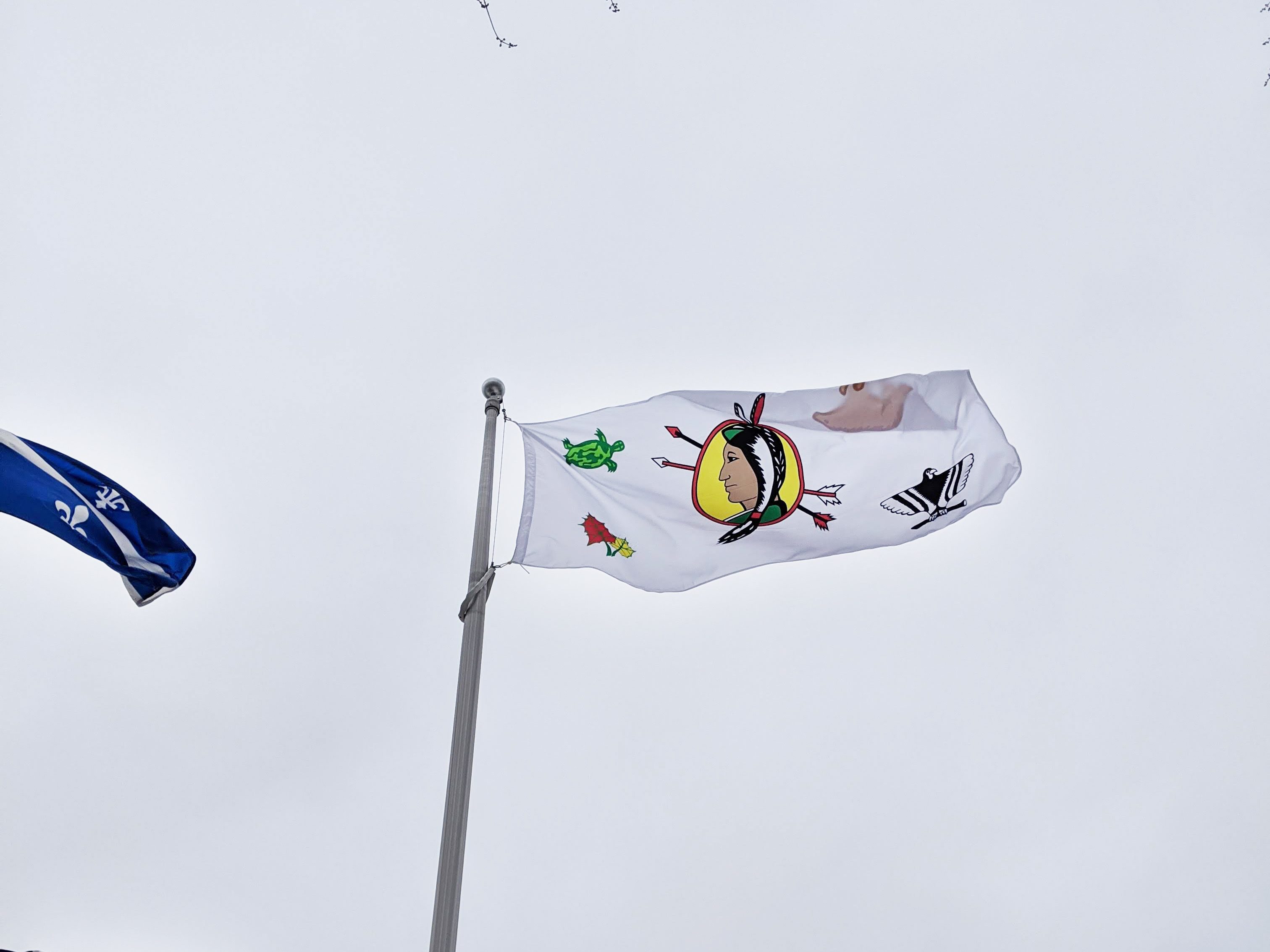
On Tuesday, March 21, Odanak Chief Richard O’Bomsawin, Principal Goldbloom, and community members gathered for the raising of the Odanak flag on Bishop’s campus.
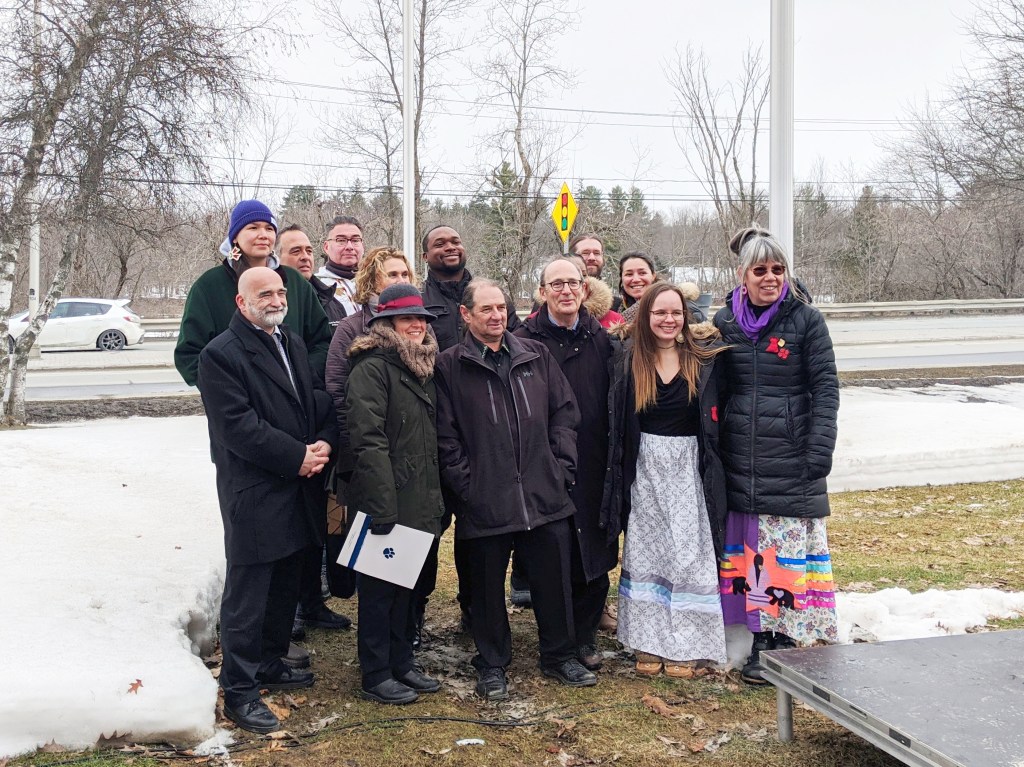
Principal Goldbloom delivered the opening message to a crowd gathered under the flag poles. He explained that the flag-raising event emerged from Bishop’s “growing relationship and respect and understanding with the Abenaki nation and its leadership.” He announced that the Kwigw8mna project – the renovation of the Divinity Building into an Indigenous student space and resource center – would include an exhibition space on Abenaki history and culture. Goldbloom also introduced Daniel Nolett and Jacques T. Watso, general manager and member of the Conseil des Abénakis d’Odanak respectively, and noted the contributions of Suzie O’Bomsawin, assistant general manager and human resources manager of Odanak council and member of the Board of Governors at Bishop’s. A councilor for the Sherbrooke city council Raïs Kibonge and the president of the borough of Lennoxville Claude Charron were also present among other government representatives.
Nancy Beattie, the campus director of Champlain College, delivered remarks acknowledging Nolett’s contributions to the Indigenous Advisory Circle at Champlain. Beattie explained Champlain’s work to support Indigenous students and the Education for Reconciliation action plan adopted in recent years.
Shawna Jerome, coordinator of Indigenous student support services, said, “Having the flag-raising today, having all the other events that are going to come after this is really important. I would like to continue the collaboration between the campuses and between the Odanak.” She nodded to her seven years on the Bishop’s/Champlain campus and the improvements she had seen over time. Noting that she had heard questions about why the Odanak flag was not raised earlier, she said it was important to remember that “these processes take time, take consultation.”
Odanak Chief Richard O’Bomsawin delivered the final remarks before the flag was raised. He expressed that it was newcomers to Turtle Island, not Indigenous communities, who used flags and the concepts associated with flags. “When they first brought the flag, they would plant it and say, ‘this is ours’,” O’Bomsawin said, referring to the land. Gesturing his arms around the crowd, he then said, “But today, we can say it is ours.” O’Bomsawin briefed the community about the symbolism within the Odanak flag. These included the bear and turtle which represented the societies within the Odanak communities, the maple leaf which represented separation with a border, and the two arrows which represented that if we come together, we build strength.
Following this, O’Bomsawin and Goldbloom raised the flag as Nolett and Watso drummed and sang an honor song. Leading into the feast song, Watso invited the crowd to join festivities in the Quad after the raising.
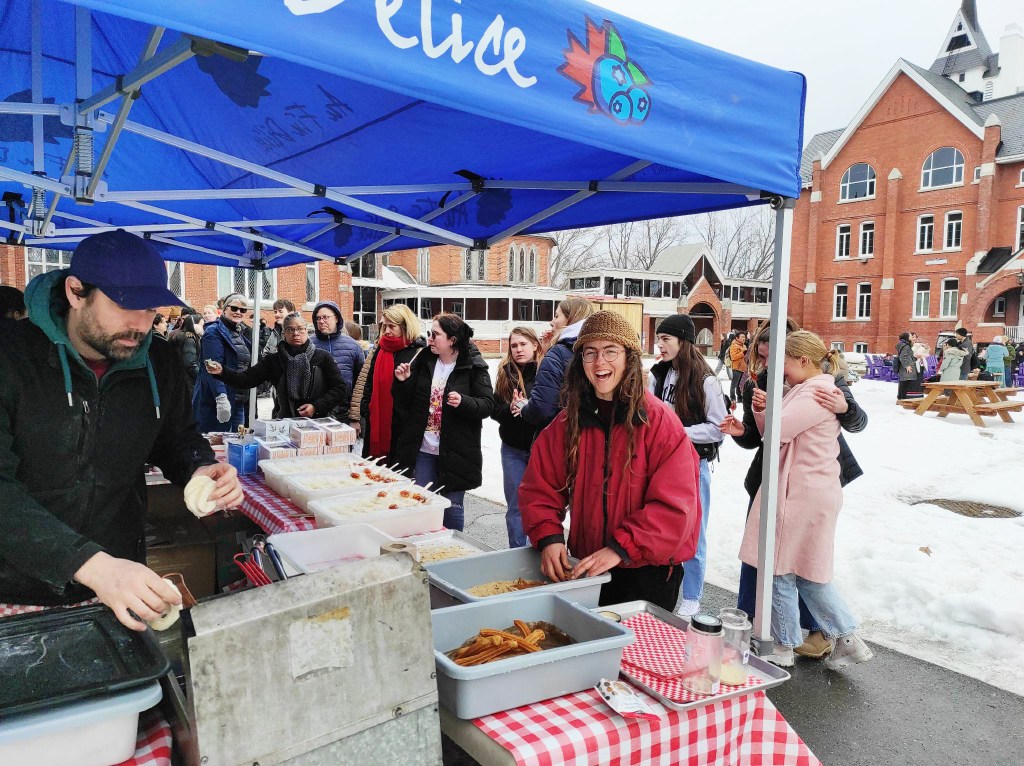
These festivities included an Abenaki language scavenger hunt, which Champlain College’s Indigenous and Intercultural Student Life Counselor Dana Lois explained to participants at the entrance of the Quad. Participants could scan QR codes on posters around campus for clues about the meaning of Abenaki words. Around the Quad, students queued in eager waiting lines for some Sagamité soup prepared by Watso, as well as other stands for sugar on snow, coffee and hot chocolate, and La Cabane à Guillaume’s cinnamon-sugar treats. Students and community members relaxed in the Quad on picnic tables and outdoor chairs recently introduced with the receding snow. Miguel Brochero, a second-year student, said, “Seeing more actions like these fill my heart.” Angie Navia, an exchange student from Colombia, found the flag-raising inspiring. She hopes that land acknowledgements can be “taken as an example in other nations,” as in her experience they are not common in Colombia. “There are always more things to be done,” she expressed.



 The Campus