
By Leo Webster – Senior Copy Editor
This year’s Research Week featured various styles of presenting research, including posters, snapshot presentations, short talks, and the relatively avant-garde video essay. The weeklong poster competition featured a variety of video essays from a horror film course, and on Monday, March 20, Dr. Gregory Brophy, Dr. Shawn Malley, and student collaborator Alexandre Bergeron, all of the English department, gave a talk on the future of the video essay.
During the talk in the Agora, there was a showing of Bergeron and Dr. Brophy’s “whitespace”, exploring the nature of white spaces in science fiction films and modern advertising, including The Matrix, Black Mirror, and early Microsoft ads. The essay explored a reality created by corporations in which there is no extant material culture, giving companies the freedom to shape the world, described by Brophy as “friction-free capitalism”.
A video essay presents an argument by editing visuals and sound from different sources. It usually leans on several primary texts and many supporting ones to represent an issue or theme, the same way an essay revolves around a thesis. It is more than just a supercut, as Dr. Brophy told his science fiction students, because it must present an actual argument, not just point out a trope in films. Bergeron, a fourth-year English student with a film concentration, added during Monday’s presentation that the argument is sometimes less clear than a conventional essay and can leave more interpretation to the viewer. While this may seem like an escape from academic rigor, this method can be beneficial for students learning to write and edit films because it teaches how to present an idea through editing and storytelling without necessarily having voiceover or text.
Dr. Brophy and Dr. Malley noted that the video essay is not yet widely accepted in academic spaces, partly because of its newness, but also because of potential copyright issues in using clips from other films. It would be much too expensive for many presses to “publish” that amount of copyrighted material, but Dr. Malley mentioned that there are some publishers interested in long-form video content.
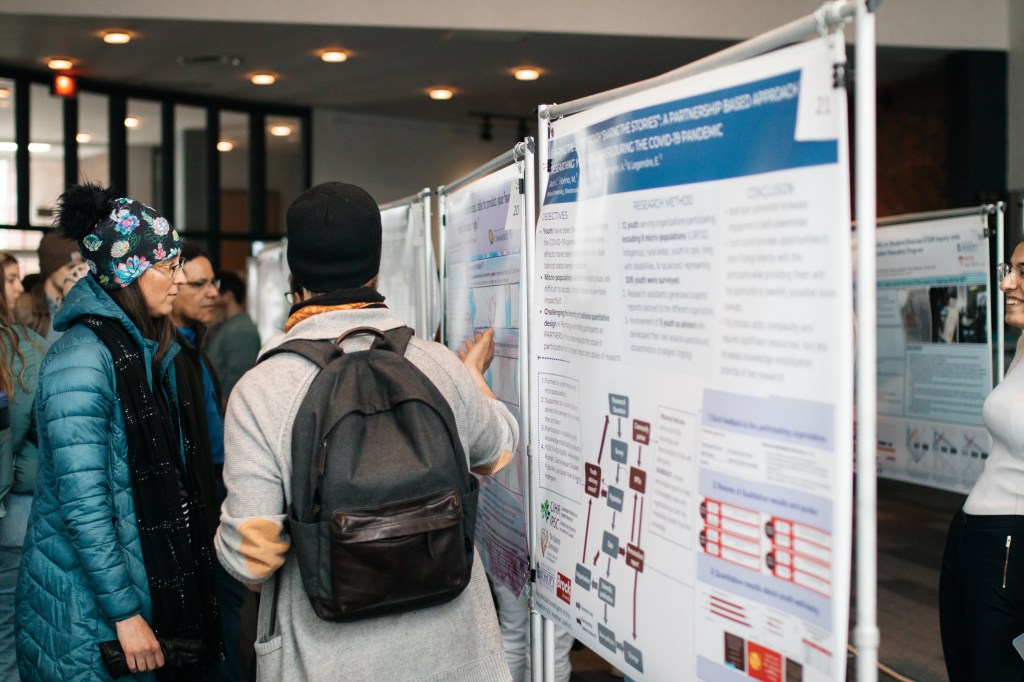
The student videos shown at the poster contest featured clips from classic and modern horror films, as well as other TV shows. The set-up lacked proper sound, an issue to be fixed in the future, so it was sometimes difficult to understand the argument of the essays while browsing other posters. That said, the range of topics and the quality of editing showed that the video essay is an appealing way for students to do research.
Lucie Casinghino, second-year English student and creator of a video essay on transgender representation in a horror film, said that she enjoys the ability to include more texts in her argument and use material from outside the course. When asked about how she found material for her essay, she said: “A lot of it comes from knowing where to look and doing your research in terms of…what are even the small connections I can still bring in. Right now I’m doing one (video essay) on corporate dystopia, so I’m trying to really broaden my scope of clips…Because that’s interesting in the way that you can bring in something and not even have to address it necessarily within the video essay.” Even though the video essay takes significantly more work than a traditional essay, the uniqueness of the creative aspect and the polished look of the final product is appealing to Casinghino. However, it is definitely the access to the broad range of material and ability to make more subtle connections between texts that draws her to the form. Casinghino shared, “There’s a lot of freedom in the video essay form, and you don’t have to limit yourself in a lot of ways.”
Many of Dr. Brophy’s film courses accept video essays as a final project, and other courses are beginning to offer this option as well, as the film program expands and academic culture embraces digital media. The creative aspect of the video essay, as well as the impressive look of the final project, has a strong appeal for film students and other artists. However, in a course where students are given multiple options for a final project, many still prefer the traditional essay, citing issues of time and technological skill as their primary concerns.

 The Campus