
By Sufia Langevin – Associate Editor
Students, faculty, staff, and community members gathered in Centennial Theatre for the March 22 Donald Lecture, the last of the school year. Dr. Esi Edugyan, author of Washington Black, was joined by Dr. Michele Murray, Dean of Arts and professor in the religion, society, and culture department. Edugyan has four honorary doctorates, one of which was awarded by Bishop’s in 2022.
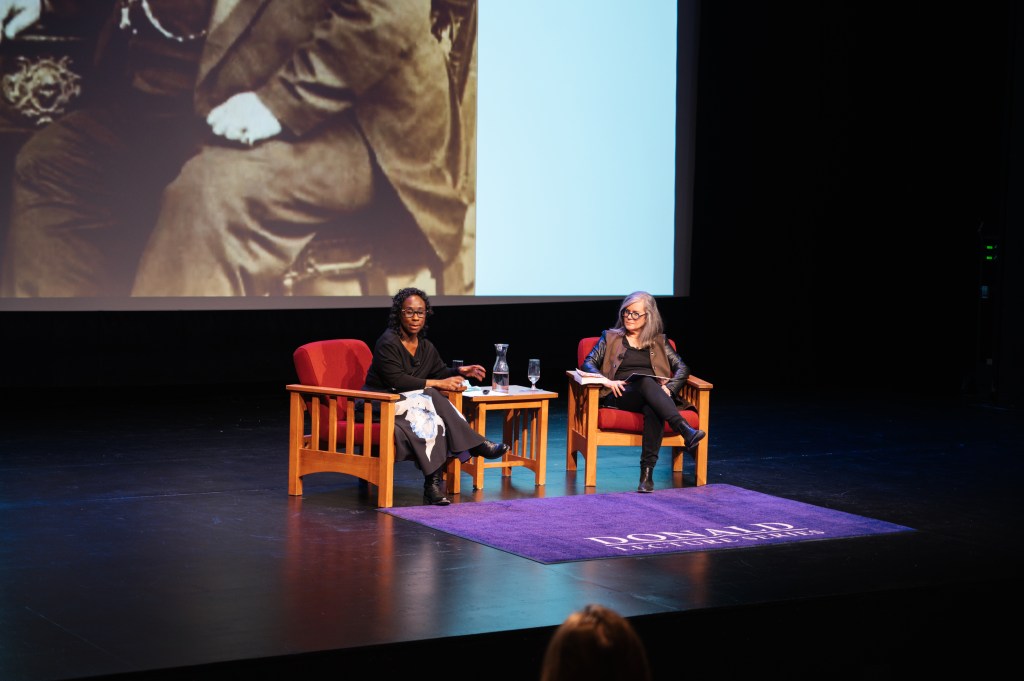
Dr. Edugyan explained her family’s history, moving from Ghana to the United States and eventually to Calgary. She felt at times like the family black sheep for wanting to go into the arts, since her mother was a nurse and her father was an economist. She claimed that being the youngest of her siblings allowed her more freedom to pursue her dreams, and that she originally was able to study English because she took journalism classes.
Dr. Edugyan spoke mainly about her book Washington Black and her writing process. Many students had the opportunity to receive a free copy, on a first-come first-serve basis. Dr. Edugyan spoke of how it took her three years to complete her novel, and that the first year was spent on research. She described the historical case that served as inspiration for the novel, and the balance between facts and creativity when writing historical fiction.
Dr. Edugyan also shared her insight for aspiring writers. Her first novel Half-Blood Blues was rejected approximately thirty times before being published. But once published, it was shortlisted for the Booker Prize, and won the Giller Prize. She encourages students to keep trying if they have written something that matters, and to not treat their writing as a hobby, but to dedicate themselves fully to their work. Her experience of being a writer means being relentless, and that books do not get written by waiting for inspiration to strike.
Dr. Murray and Dr. Edugyan also spoke about the importance of the humanities. Dr. Edugyan raised the point that during the pandemic, book sales skyrocketed as a result of people turning to art and writing during a time of crisis. Specifically, people turned to books that reflected some of their experiences and uncertainties, such as The Plague by Albert Camus, and 1984 by George Orwell. Literature does not necessarily provide the answers directly, but imbues hope into the reader.
One of the most impactful ideas that Dr. Edugyan brought forward is that “every novel is a radical act of empathy,” since situating oneself in the perspectives of others requires humanity. She stated that bridging the disparity between one’s own experiences and the experiences of others allows us to better understand one another. This message is inherently hopeful and encourages empathy and community care.
Dr. Edugyan’s Donald Lecture was a wonderful and insightful conversation that left students feeling hopeful and engaged, with particularly helpful advice for aspiring writers. There were many questions and comments from the audience concerning writing advice, historical lessons and specifics of her novel Washington Black. The event closed with a thank you to Principal Goldbloom, who worked with John Donald to create the Donald Lecture Series. This was Goldbloom’s last Donald Lecture as principal of Bishop’s University.


 The Campus