
By Danielle Storey — Contributor
Bishop’s University just wrapped up Eco-Week, a full week of events that promote sustainability and green practices across campus. From Monday to Friday, the Environmental Club, Sustainable Development Office, other extracurricular groups, and the Eco-Week Planning Committee hosted numerous events with the main goal to educate students and faculty about the environment while making sure that the events were engaging and fun!

There were a variety of activities throughout Eco-Week to ensure there was something for everyone. For those interested in fashion, there was a thrift store to promote second life cycles for clothing, and a mending workshop hosted by the Art Lab to repair and spice up old clothes. For those who enjoy physical activity, the Sustainable Development Office and Vélo Québec hosted a winter bike kiosk allowing students to test drive winter bikes for themselves. There was Fair Trade hot chocolate available at numerous events, a conference about hurricanes hosted by the co-chair of the environmental department Dr. Matthew Peros, and a mini market.
What is a mini market? The mini market was an event that gathered environmental clubs, sustainable groups, and local artists in the student union building to promote their group or sell their locally made products. The mini market was an important inclusion in this year’s Eco-Week because of its minimal environmental impact. Some artists were selling jewelry made of recycled materials like old phone cords, others were selling paintings, and even the Sustainable Agriculture and Food Systems (SAFS) Club sold germination kits so you can grow your own plants at home! Buying local products promotes fair pay for the artisans while also cutting down on emissions produced by retail stores that mass produce items in bulk. In addition, the students selling their products encourage small scale agriculture which is significantly less impactful than conventional agriculture.
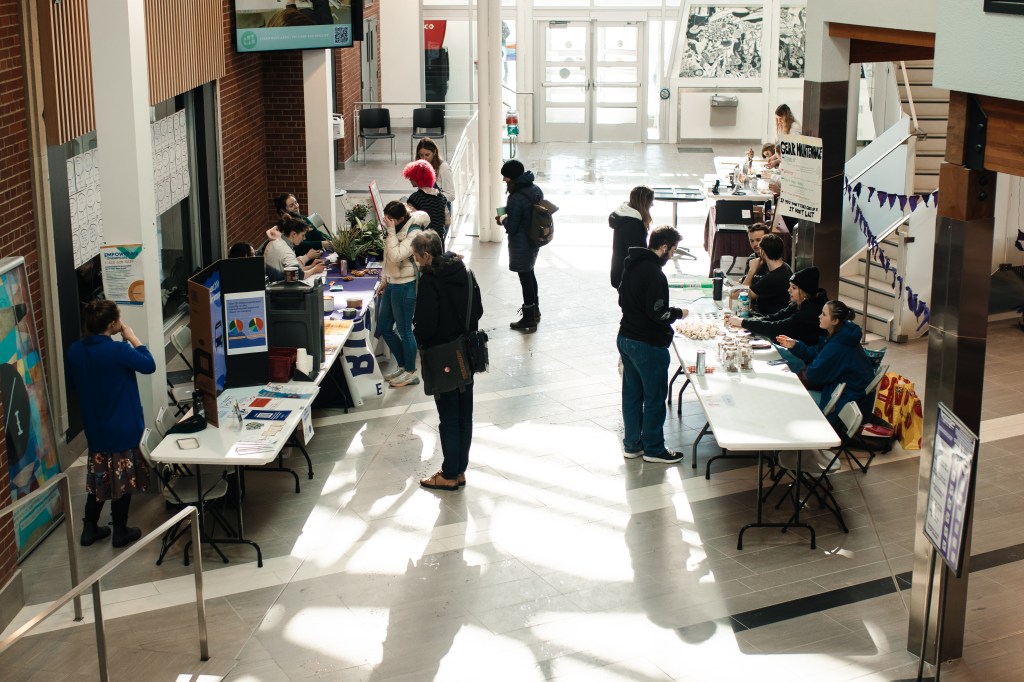
Not only is the mini market beneficial for the environment, but it is also beneficial to the local economy. When money is kept local, it is paying salaries to the community’s citizens and helps to support local businesses. Additionally, purchasing from small-scale and community-based businesses can contribute to the local tax base, thus increasing values of assets, properties, and incomes within the community.
For every 100 dollars spent at a local business, 73 dollars remain in your community, according to a Michigan State University report. Whereas for every 100 dollars spent non-locally, only 43 dollars will return to the community. Money is lost to non-local supplies, supporting factory farms (which are huge contributors to climate change), and lost to non-local services. By purchasing online, not only are you contributing to the increase in emissions from shipping services, but you are also increasing the tax base of larger cities, contributing to the rise in living costs.
To conclude, it is essential to promote local businesses and artists to help the environment thrive. Climate change is largely affected by mass production, industrial agricultural practices and transportation emissions. By shopping locally, citizens will be promoting local businesses, minimizing their ecological footprint, helping create jobs for local citizens, paying local salaries, and ameliorating the local tax base, giving your own community more value.
Eco-Week 2024 will likely host another mini market, and we hope that you choose to attend and support Bishop’s students, the environment, and the economy!



 The Campus