
Erik Morrison – Economics & Business Editor
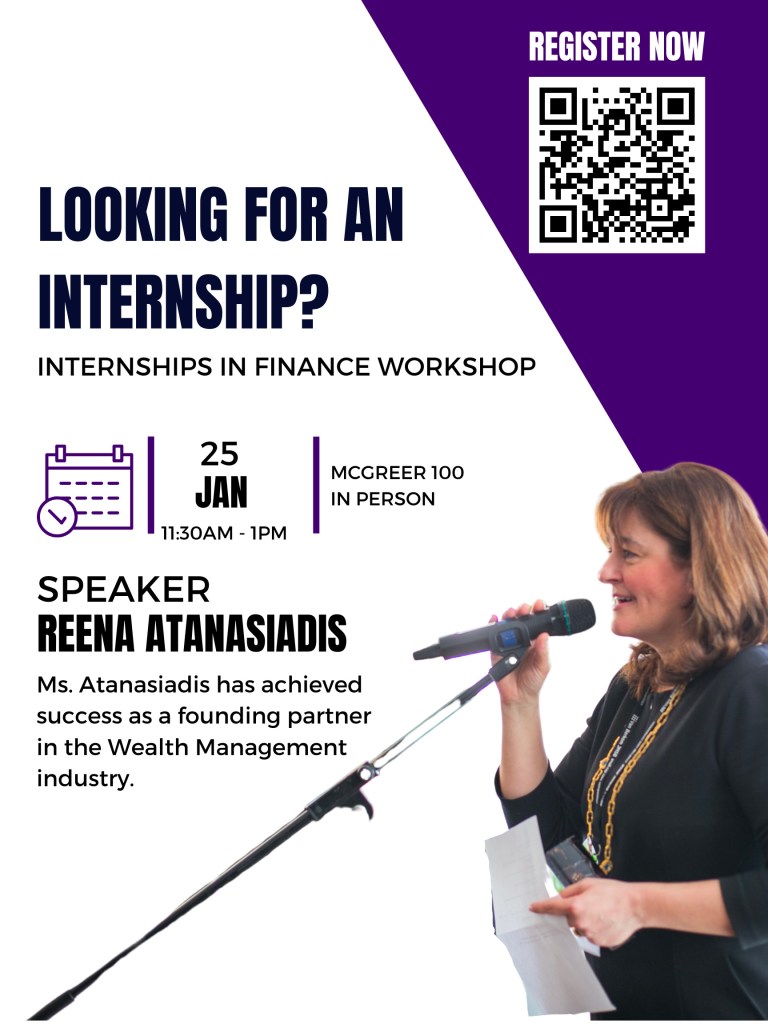
On Wednesday, Jan. 25, Reena Atanasiadis, the Dean of the Williams School of Business, hosted a workshop on opportunities for internships in finance and provided some of her best advice on how finance students can excel and stand out from other internship applicants in such a competitive industry. The event was organized by the WSB Cooperative Education Office, Marcia Boisvert, and WSB student Mika Rohac-Grenier as a way to guide students looking to enter finance as a career.
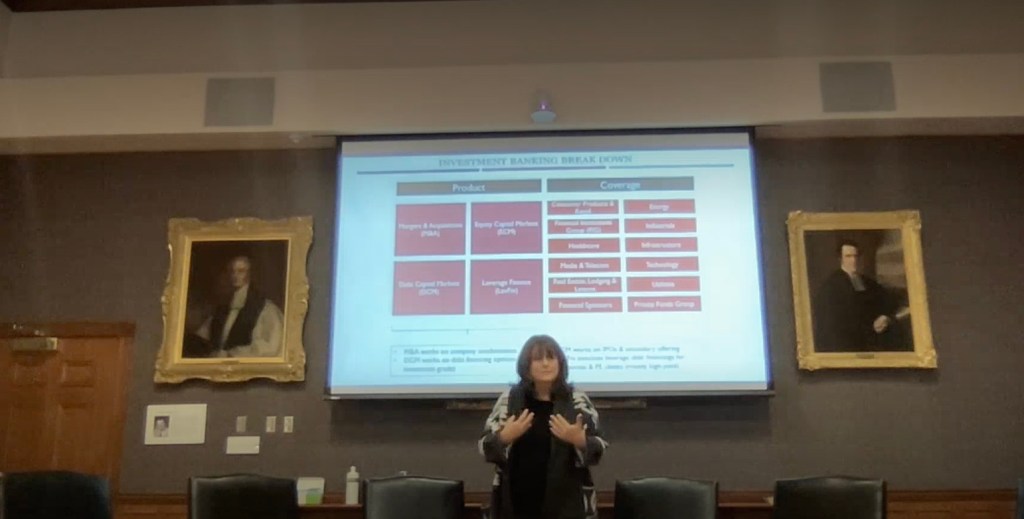
Atanasiadis’s goal of the bootcamp was for students to leave knowing something new about the critical steps to succeed in finance, the barriers that exist to enter the capital markets space, and how to knock down those gates. Atanasiadis also explained tips to perfect your CV, succeed in different interview styles, and make sure you prepare for interviews in a way that is catered specifically to each firm. The person interviewing you likely has 10 to 15 years of experience, and it is important to use facts and be confident in your responses.
Not every finance role is similar. The boot camp focused on careers in the two sides of market finance. There is the “buy side” and “sell side.” The buy side of market finance performs proprietary research to decide which companies to purchase. Some examples include pension funds that provide returns to the pensioners, or mutual funds that provide returns to investors in that fund. The sell side, which represents the vast majority of careers in finance, is the investment banking side. Major banks, such as the Royal Bank of Canada, make up some of the largest players in Canada.
To become an investment banker, it is important to work hard to obtain an average of at least 85 per cent. You also must prepare to work long hours. It is not uncommon to add up to 120-hour work weeks. Atanasiadis shared her passion for the investment banking industry: “You’re never going to work with more intelligent, driven, and passionate people than a bunch of investment bankers. It’s probably the most thrilling job on the planet.”
Atanasiadis spoke about some of the necessities for finance students to prepare their resumes. Your CV should not be three pages long or you will not get an interview. Keep it to a maximum of one page as a junior applicant. You should always include your GPA on the resume and it should ideally be one of the first things the hiring manager sees at the top. Additionally, when preparing your resumé, make sure you do not stretch the truth about your skills or abilities. The company will question you and when you get caught in a lie, you lose any chance at landing that job.
Atanasiadis was clear that a large variety of first-time jobs can open the door to a career in finance. “It bothers me when people say the only experience they have is being a busboy. The things you learn being a busboy are exactly the things that you need to be successful in life. First of all, you must deal with people such as customers, bosses, and coworkers who can be hard to work with. You are constantly under pressure. Mistakes are going to happen, whether it’s in the kitchen, or with your colleagues. You must work as a team. You need to communicate effectively and politely, even when you feel like walking out.” These are transferable skills that make you worthy of a career in finance. As long as you can sell yourself and make it clear that your experience as a busboy can apply to their industry, you have a chance. Atanasiadis told students, “I promise it will be the most amazing career in your life.”




 The Campus