
By Gabrielle Liu – Junior Copy Editor
Bishop’s University obtained a VéloSympathique certification on Jan. 18, after a year-long journey spearheaded by the Sustainable Development Office. Sonia Patenaude, Manager of Communications, welcomed a modest crowd surrounding the gazebo before Isabelle Goyette, the Vice-Principal Finance and Administration, introduced the certification’s connection to Bishop’s 2020-2024 sustainable development plan. Becoming a bike-friendly campus was in line with the plan’s four main priorities: operating Bishop’s in a more ecological and responsible manner, engaging the community in improving its sustainable performance, using education and research to instill curiosity in sustainable development, and promoting the wellbeing of the community through sustainable initiatives.

Magali Bebrone, a representative from Vélo Québec, then formally announced that Bishop’s University had been given the Bronze award in becoming a bike-friendly campus. The award was deserved because of a commitment to promoting bikes as “a viable mobility option” on-campus, Bebrone said. “This program is more than an award. It is a continuous process of spreading biking culture across Québec,” she said of VéloSympathique. Bishop’s is now one of 27 campuses across the province who have been certified under the program, Bebrone added. She clarified that these awards are given by an independent panel of judges who assess each organization, city, or campus by five pillars: environment, education, encouragement, evaluation and planning, and equity.
When asked about the challenges a small versus large campus faces in obtaining a VéloSympathique certification, Bebrone spoke about how judging processes were complex, “taking into account each campus’ reality,” such as by factoring in how many people might be coming to campus from much further distances. The judging tends to place a strong emphasis on the pillar of ‘environment’, looking at elements such as how many bike racks there were and whether there were showers for commuters or lockers for bikers. Laurence Williams, the Sustainable Development Advisor, later mentioned that improving infrastructure was one of the main focuses for the Bishop’s Sustainable Development Office in the last year – the office sent out a survey last year collecting feedback on where bike racks were most needed on campus. Their office has an updated list of racks that can be found on an interactive map under their page on the Bishop’s website.
However, material infrastructure is only part of the equation– other pillars target cycling culture, and that is where Vélo Québec representative Louis Lalonde jumped in with “because Bishop’s is smaller, it is more agile.” He suggested that the sense of community here helps with building cycling culture, pointing out the number of people who were attracted by the press conference itself. “Bishop’s is tightly knit as a community,” he observed, “just because a school is smaller, that doesn’t mean it can’t build culture.” Williams suggested that Bishop’s small size made it easier to nudge “collective change.” One of the highlights of this certification process was seeing the amount of bikers on campus, and knowing that “people are willing to make the shift.” She recalled work done during the national biking month of May to incentivise biking to campus and the free bike mechanic kiosk that had been offered in September.
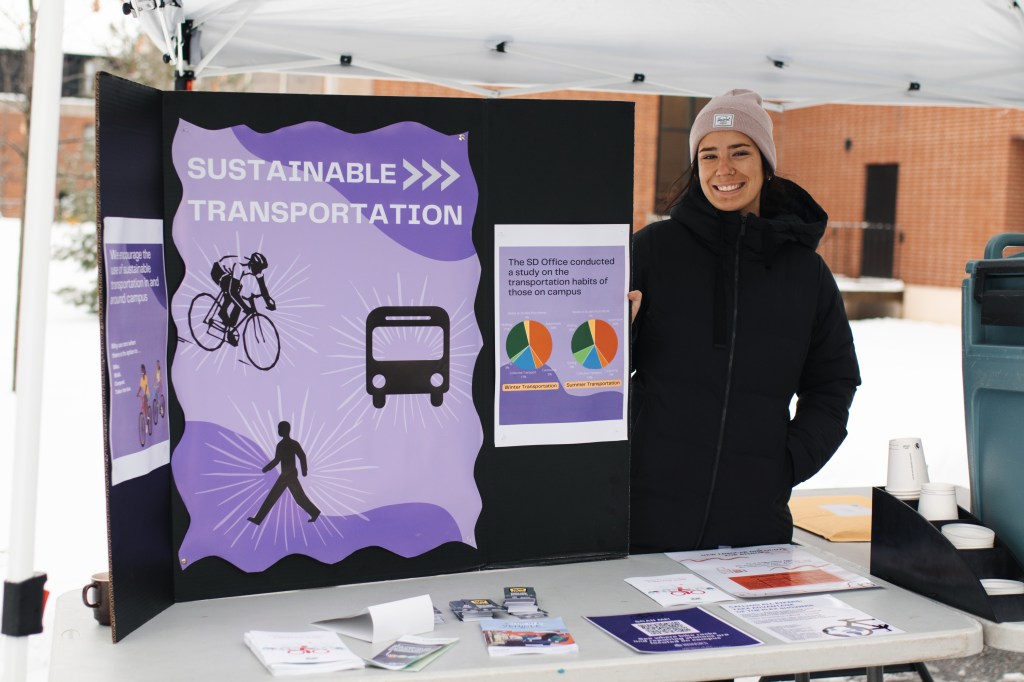
When asked about the next steps after the certification, Williams said that “for sure” the Sustainable Development Office would be working towards a silver and gold certification. She recalled the transportation survey conducted the school year prior, which had found that on average roughly 10 per cent of people at Bishop’s cycle to campus in the summer, and 3 per cent do in the winter. As a winter biker for 10-15 years now, Williams sees a future for winter biking despite those numbers – but points out that “it’s really a matter of city infrastructure” of safe bike lanes that will push the transition. Furthermore, while that 3 per cent of winter bikers may ring low, for her it proves that the work they have been doing has touched the community.



 The Campus